
Energy as a Service for Australian Businesses: Costs and Financing
Australia's energy-as-a-service market was valued at A$1.89 billion in 2025 and is forecast to reach A$4.39 billion by 2035, with projected growth of 8.80% from 2026 to 2035. For businesses, energy as a service in Australia means paying for an agreed energy-service outcome rather than each unit of energy consumed. A provider can design, finance, operate and maintain the assets behind that outcome.
▮Key Takeaways
- Energy-as-a-Service may cover more than on-site generation: projects can include batteries, demand response, refrigeration, heating, lighting and equipment upgrades.
- Map your energy use and operating needs before assessing a proposal. This helps clarify which assets and services should sit within the project.
- Compare the service outcome, ongoing fee and responsibilities for operating and maintaining assets, not just the equipment being installed.
- Efficiency and optimisation, along with third-party providers, are projected to be growing parts of Australia's market through 2035.
- Use the market outlook as context, then judge a project by how its design and financing fit your business's energy needs.
This model can reduce the upfront cost of energy equipment and shift some demand-management responsibilities to a supplier. Its value depends on how well the project fits a business's energy use and whether the payment terms make sense. An ongoing fee is worth considering only when the service and costs are clear.
This guide explains how Energy-as-a-Service works, what providers may include and which factors shape project costs and financing in Australia. It also explores the market's growth outlook, helping you understand the broader shift and assess whether this approach suits your business's energy needs.
▮Competitive landscape and leading companies
Australia's EaaS market includes third-party providers and energy partners. Compare the work each will deliver, not just the company name.
Providers compete through the project they can deliver, such as improving compressed-air systems or replacing a gas boiler with an electric or hybrid alternative. A business may also modernise motors, pumps, cooling or refrigeration. These are different jobs, so compare proposals against the same site need, equipment and service outcome. Australia's third-party provider segment is projected to grow at a CAGR of 9.3% from 2026 to 2035.
Upfront cost is one key difference from buying a system outright. With a direct purchase, the business pays for the equipment and arranges its operation and maintenance. An EaaS arrangement can spread asset costs across an ongoing fee, while the provider designs and operates the project. Compare the total payment commitment, included services, asset ownership and end-of-agreement arrangements. A lower initial outlay alone does not show which option costs less over the full term.
Provider continuity matters because energy equipment can serve a site for years. Before signing, identify the contracting entity, who owns the assets, who maintains them and who is responsible if the service provider changes. Get operating duties, performance measures, payment terms and exit arrangements in writing. For example, clarify who handles maintenance if the original project partner stops operating the system. These details make responsibilities clear, beyond a company name or sales description.
Energy Companies and Plan Availability
Energy retailers sell electricity plans; EaaS providers arrange a service around a business site. Availability depends on the project, equipment and operating needs, not simply the retail plan offered at an address. Compare proposals with the same usage period and energy bills. Check which assets, maintenance tasks and service outcomes each fee covers. If a salesperson approaches a consumer about a new energy contract, the consumer has 10 business days to cancel it at no cost. That rule concerns the energy contract, not every EaaS agreement.
Provider Choice and State Differences
Choose a provider by matching its project scope to your site's energy use, then compare the written service, finance and operating terms before signing. Use bills and equipment records to describe demand, and clarify who designs, maintains and owns the system. EaaS differs by state through market conditions and project opportunities, rather than one uniform national offer. Western Australia's market is projected to grow at a CAGR of 9.4% from 2026 to 2035; Victoria's at 8.5%, and Queensland's at 8.3%. The Australian Capital Territory accounted for 2.4% of Australia's market in 2025.
▮Energy partner design, finance, operation and maintenance
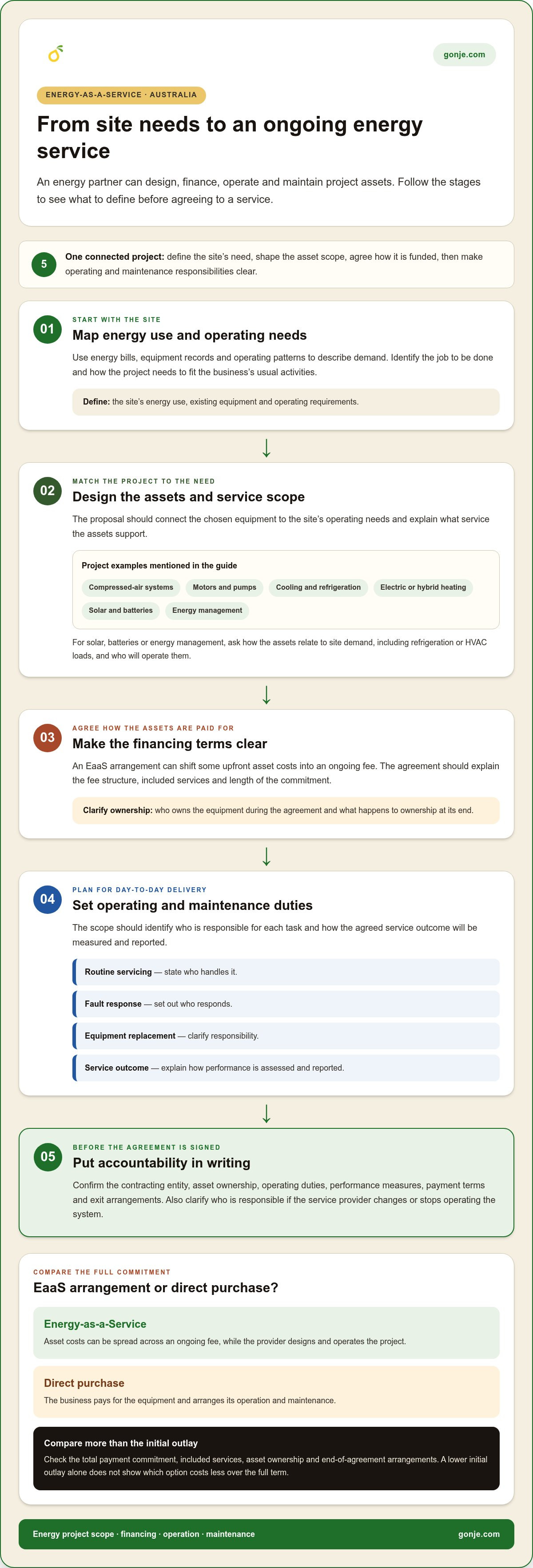
An energy partner can manage a project from initial design through ongoing maintenance. For an Australian business, the agreement should state who handles each stage and how the service is paid for.
Design, Finance and Ongoing Service
The partner may design, deliver, operate and maintain the assets. For example, a project might replace a site's gas boiler with an electric or hybrid system. The proposal should link the chosen equipment to the business's operating needs, then explain who funds and maintains it. Look for clear responsibilities, not just an equipment list.
Start with the site and the job to be done. A partner may review energy use, existing equipment and operating patterns to shape the project. An upgrade to compressed-air equipment, for instance, needs a different design from a heating-system replacement. The proposal should explain which assets are included, what service they support and how they will operate alongside the business's usual activities.
Financing determines who pays for assets and when. An EaaS arrangement can shift some upfront asset costs into an ongoing fee. The contract should explain the fee structure, the services it covers and the length of the commitment. It should also state who owns the equipment during the agreement and at its end. These terms help a business compare a financed service with buying and managing equipment itself.
Set out operating and maintenance duties before work begins. A useful scope identifies who is responsible for each task, such as routine servicing, fault response and equipment replacement. It should also explain how the partner measures the agreed service outcome and reports performance. For a pump upgrade, for example, the agreement can specify who maintains the pump and how its operation is assessed. Clear terms make day-to-day responsibilities easier to manage.
Solar, Batteries and Energy Management
Solar and batteries can be part of an EaaS project, alongside energy management. The partner's design should explain how those assets relate to the site's demand. A battery may support demand response, while energy management can help coordinate when equipment uses or exports electricity. The proposal should state which assets and services are included and who operates them.
Consider the whole system, not a battery or solar panel in isolation. A business with refrigeration or HVAC may need demand management that considers those loads alongside generation and storage. The partner can explain how it manages electricity imports and exports from distributed energy resources. This makes the intended operation easier to understand before the business commits.
For a project built around Energy as a Service, compare the design, funding, operation and maintenance as one service scope. The clearest proposal connects each asset to a business need and assigns responsibility for its ongoing care.
▮Australian energy-as-a-service market size and forecast
Australia's energy-as-a-service market was valued at A$1.89 billion in 2025. It is forecast to reach A$4.39 billion by 2035, with projected growth of 8.80% from 2026 to 2035. These figures show a growing market, but they don't establish whether a particular site's project will stack up.
For businesses, the forecast provides context, not a project budget. Market growth may reflect more providers, a wider range of services or increased demand for efficiency projects. A food processor assessing refrigeration, for example, still needs to consider its own equipment, operating hours and energy use. The national forecast cannot determine whether a particular upgrade suits its site.
The efficiency and optimisation segment is projected to grow at a CAGR of 9.7% from 2026 to 2035. That points to a stronger market focus on using energy more effectively, not only adding generation assets. Projects could target process equipment, heating, cooling or demand management. For a business, the practical question is which part of its operation an agreement would address.
Market growth also has a financing dimension. A third-party arrangement can place project design and asset operation with an energy partner, while the business pays an ongoing fee. As providers develop their offerings, compare the service scope and contract terms, not just the market's headline size. A larger market does not make every proposal suitable for every site.
Australia's government measures relevant to the wider energy system include A$23 billion invested in November 2023 to upgrade the grid and enhance energy performance. Rewiring the Nation is an A$20 billion program to modernise the electricity grid and deliver new and upgraded transmission infrastructure. These are grid-focused programs, not rebates paid directly to a business for an EaaS project. Project agreements must also account for applicable electricity-market and network requirements.
Use the forecast as a starting point, then assess the project in three steps:
- Identify the site's energy-intensive equipment, such as refrigeration or compressed air.
- Define the service outcome the business needs, such as efficient operation or managed demand.
- Compare the proposed fee, included assets, ongoing duties and contract term.
These steps connect national market trends with a real operating decision. A business with high refrigeration demand might consider equipment upgrades and demand management. A site planning solar and batteries might instead focus on how generation, storage and electricity imports work together. Australia's projected market growth provides context; the equipment, service scope and financing terms determine whether a proposal fits the business.
▮Energy-as-a-Service definition and financing
Energy-as-a-Service changes what a business pays for. Rather than buying energy assets outright and managing them, a business can pay for an energy-service outcome. This shifts the focus from energy volume to optimisation. For example, a site might pay for an agreed heating service rather than funding all its heating equipment upfront.
That difference changes the commercial incentive. A conventional energy sale is tied to the units consumed. An EaaS model can reward better management of the equipment and energy used to deliver the service. For a business with energy-intensive refrigeration, a project might focus on keeping cooling equipment operating efficiently. The agreement needs to define the service outcome and how the parties will assess it.
Financing can also change when expenditure occurs. Solar panels and batteries may require upfront investment when purchased directly. Under an EaaS arrangement, the provider can spread those asset costs across an ongoing fee. This can leave business capital available for core priorities, while the fee covers an agreed energy-service outcome. Compare the full payment terms with the costs and responsibilities of owning the assets.
An arrangement may shift some energy-demand management responsibilities and risks from the business to the supplier, but that does not mean every risk disappears. The contract should distinguish what the supplier manages from what remains the business's responsibility. A business using heating, refrigeration and lighting, for example, needs to know which equipment and energy-management tasks the agreement covers.
Before comparing financing options, separate the proposal into these parts:
- Assets: Identify whether solar, batteries or other equipment are part of the project.
- Payment: Read how the ongoing fee is calculated and what service it covers.
- Outcome: Find the agreed energy service and how performance is measured.
- Responsibilities: Note which demand-management duties move to the supplier.
These details help distinguish an asset purchase from a service arrangement. With a direct purchase, the business funds the equipment and organises its operation. With EaaS, a supplier may finance the assets and provide the service for an ongoing fee. Compare the full commitment, not just the upfront amount or equipment list.
For example, a business considering solar and batteries can compare buying both assets with paying for an agreed energy service. A useful comparison includes the fee, the service outcome and who manages energy demand. This makes the financing model easier to assess against the business's cash priorities and day-to-day operations.
▮What services are included in Australian EaaS offerings, such as solar, batteries, and energy management?
An Australian EaaS project can combine equipment, energy management and an agreed service. Solar and batteries are options, but the scope can extend to heating, lighting, vehicle charging and mobility. A business should match each service to a practical site need. For example, a warehouse may consider lighting and vehicle charging, while a food site may focus on refrigeration.
Generation and storage can work alongside demand response. Batteries can help a business manage electricity use and support grid stability. Energy management can also coordinate distributed energy resources, including electricity imports and exports. The proposal should explain which assets and activities it covers. For example, clarify whether the service manages a battery alongside the site's electricity demand.
Equipment upgrades are another part of the mix. An EaaS project can upgrade industrial cooling and refrigeration to more efficient, lower-carbon technology. It can also target compressed-air systems, motors, pumps or process equipment. These projects address different loads: a refrigeration upgrade meets different operational needs from a pump modernisation. Define the equipment and intended service clearly.
Energy management can include optimising demand from heat pumps, pool pumps and HVAC. The aim is to coordinate when equipment uses energy, rather than treating every load separately. For example, a site with HVAC and refrigeration can assess how both systems contribute to its demand. Demand flexibility can also help coordinate distributed energy resources with changing site needs.
Possible service components include:
- Solar generation and battery storage.
- Demand response and coordination of imports or exports.
- Efficient cooling and commercial refrigeration upgrades.
- Heating, lighting, vehicle charging and mobility services.
- Demand optimisation for heat pumps, pool pumps and HVAC.
To shape a useful scope, first list the site's energy-intensive equipment. Then identify whether the priority is generation, storage, efficient operation or flexible demand. A business with industrial cooling may centre the project on refrigeration, while a site with vehicle charging may consider mobility and load management. The service should address a clearly identified operating need.
For a project that brings these elements together, explore energy service options and consider which equipment and energy tasks matter most at your site.
▮Gonje: Multicultural & Specialty Food Delivery
Gonje offers multicultural and specialty food delivery, ready-to-eat restaurant meals, everyday groceries and Software as a Service. These offerings support different business needs from an energy project, including food ordering, grocery supply and merchant operations.
For Australian businesses, Gonje may be relevant when sourcing diverse food or everyday groceries is part of serving customers or staff. Merchants can also explore its software service for operational needs. Gonje is not a substitute for an energy partner, solar project or energy-management agreement. Keep those decisions separate and choose each service for the job it serves.
If Gonje's food, grocery or software offerings suit your needs, visit Gonje online to learn more.
▮Put your next energy decision into motion
Next, turn your site's energy priorities into a clear brief. Note which equipment matters most, what service you need and how you want to fund it. This gives your business a practical starting point for discussing energy as a service in Australia while keeping day-to-day operations in view.
Gonje offers Energy as a Service alongside multicultural and specialty food delivery, ready-to-eat restaurant meals and Software as a Service. These offerings meet different needs, so choose the one that fits the task at hand. For an energy-related enquiry, bring your priorities and questions to the conversation.
Contact Gonje about energy services to take the next step. A considered start can help your business move towards an energy approach that fits its work and priorities.
▮Frequently Asked Questions
What is Energy-as-a-Service?
Energy-as-a-Service is a model in which a business pays for an energy service rather than buying and managing every asset itself. Under an agreement, the service may cover equipment, operation and ongoing maintenance. For example, a business could contract for a heating outcome while a provider manages the equipment behind it. The contract sets out the service scope, payment terms and responsibilities for both parties.
What does energy as a service (EaaS) mean in Australia?
In Australia, energy as a service gives businesses another way to organise commercial energy projects and services. It can bring together equipment such as solar, batteries or efficient cooling with energy management under one arrangement. At a site with refrigeration and HVAC, the service scope can address both loads. Its value depends on how well the terms fit the site's operating needs and energy priorities.
Which Australian energy as a service providers and plans are available?
Gonje offers Energy as a Service for commercial energy management and efficiency. Providers' services and agreement structures vary, so compare the actual project scope rather than relying on a plan label. Consider which equipment and energy tasks are covered, who operates them, how the service is measured and how payment works. A business with solar already installed, for example, may need a different scope from one planning a new system.
How much does energy as a service cost in Australia, and what are typical fees or savings?
There is no single cost or saving that applies to every Australian EaaS project. The fee depends on the assets included, the service provided, the financing structure and the agreement's duration. Site demand and the equipment being upgraded also affect project economics. To compare an offer with buying equipment, consider all payments and operating responsibilities across the agreement, not only the initial outlay.
How do EaaS contracts, ownership, and payment models work in Australia?
An EaaS contract sets out the service, fee, asset responsibilities and agreement term. Ownership depends on the arrangement, so the contract should state who owns each asset during the term and what happens at the end. For example, a business considering a battery should understand who operates and maintains it. Payment may take the form of an ongoing service fee rather than an upfront equipment purchase.
What are the benefits and drawbacks of EaaS compared with buying solar panels and batteries outright?
EaaS can reduce upfront asset spending and shift some operating and demand-management duties to a supplier. Buying solar panels and batteries outright gives the business direct ownership, but it must fund and manage the assets. Compare ongoing fees and contract commitments with the purchase cost and responsibilities of ownership. A business with available capital and in-house energy expertise may weigh these trade-offs differently from one prioritising capital for core operations.
What risks, contract terms, and exit fees should customers check before signing an EaaS agreement?
Read the clauses covering service performance, fees, maintenance, asset ownership, contract duration and early exit. Check what happens if equipment fails, the business's operating needs change, or the agreement ends early. The contract should identify each party's duties and explain any exit charges and how they are calculated. For instance, confirm whether removing or transferring equipment creates additional obligations. Clear written terms can help prevent surprises later.
What Australian government rebates, incentives, and regulations apply to energy as a service?
The A$23 billion grid upgrade investment and A$20 billion Rewiring the Nation program support grid infrastructure; they are not direct business rebates for EaaS projects.
 Tiktok
