
Restaurant Delivery Management Software Australia
October 20, 2026

A delivery order shouldn't require a separate kitchen routine for every app. Restaurant delivery management software can bring orders from third-party platforms into one view and connect online ordering with a restaurant's point-of-sale system. Depending on the setup, it can also send orders to the POS, keep menus current across platforms and locations, and organise kitchen tickets.
Running delivery alongside dine-in service means keeping orders, menu changes and stock in sync. When those details are spread across different screens, staff lose time switching between them. The right software can bring the work into a clearer routine, although tools and integrations vary by system.
This guide explains what delivery management software does, how it supports menus across platforms and restaurant locations, and what to consider when comparing Australian providers. It also looks at how these systems suit different operations, from a single kitchen to a group of venues.
Key Takeaways
- Separate order aggregation from deeper POS integration to see which setup fits your kitchen's workflow.
- Compare providers by how they handle order flow, menu changes and the systems your restaurant already uses.
- Plan menu updates around platform differences, stock changes and the needs of each location.
- For restaurant groups, map shared processes and local outlet needs before rolling out a system.
- Explore the Australian provider directory to understand the different ways businesses support restaurant delivery operations.
▮ What is Food Delivery Management Software?
Restaurant delivery management software brings online orders into a shared workflow, linking ordering channels with kitchen and sales processes. In Australia, restaurants need to protect customer information, handle payments appropriately and follow the food-safety requirements that apply to their operations.
To see how a delivery management system handles restaurant orders, watch this demonstration:
Restaurant Ordering and Delivery Software Providers
Providers generally fall into a few practical groups: order aggregators, POS integration services and online ordering systems. An aggregator brings orders from third-party delivery platforms into one view. POS integration connects incoming orders with the restaurant's existing sales system. Some systems combine these functions; others focus on one part of order management. Compare the workflow each provider supports with what your kitchen needs.
Order Assembly and Kitchen Displays
A kitchen display shows incoming orders for staff to prepare and assemble. For example, a restaurant handling dine-in and delivery can view both streams in its order workflow rather than relying on separate paper slips. Some delivery systems can also send orders to a kitchen printer. Check how the display sorts orders, shows item details and helps staff move each ticket from preparation to packing.
Order Tracking and Customer Updates
Order tracking lets customers and restaurant staff follow an order's progress. Notifications can show steps such as order received, preparation underway or ready for collection. These updates help set expectations while the kitchen prepares the meal. Consider which details the system shares, when it sends messages and whether staff can manage delays without interrupting food preparation or packing.
POS and Ordering Integrations
Integration determines how orders move between third-party platforms and a restaurant's POS. With a compatible connection, an online order can go straight to the POS instead of being re-entered by staff. The POS can also bring online and in-house sales data together for reporting, while inventory updates can flag unavailable items. Trace an order from customer checkout to kitchen ticket to identify any remaining manual steps.
Online and QR Ordering
An online ordering website lets customers browse a restaurant's menu and order through its own channel. QR ordering gives diners another option: they scan a code to open the menu and submit an order. When systems connect, both options can feed into the same kitchen workflow as delivery platforms. Review how menu edits appear, how orders reach staff and how payment fits into each process.
▮ Food delivery management software definition
Food delivery management software helps restaurants receive, organise and fulfil orders from digital channels. Third-party integrations can make operations more convenient, but they also create risks: a connection failure or menu mismatch can disrupt order handling and customer expectations.
Definitions and Software Categories
The term covers several kinds of software, not one fixed product. An order aggregator gathers orders from delivery platforms; a direct-order system manages orders placed through a restaurant's own website. A broader management system may connect ordering, the POS, kitchen workflows and reporting. When comparing categories, trace a sample order from checkout to preparation and identify which steps the software handles.
Delivery System Features
Features can include order intake, menu controls, POS connections, kitchen ticket routing and sales analytics. For example, a connected system may send an online order to the POS, then pass its items to kitchen staff. Inventory tools can help identify unavailable dishes. Check how features work together and whether staff still need to re-enter information between delivery platforms and existing systems.
Food delivery businesses can use different revenue models. A marketplace may earn through order commissions, restaurant advertising, delivery fees or variable prices. A restaurant's own ordering channel works differently: the restaurant manages the customer-facing menu and order flow, while delivery arrangements depend on its operating model. Separate software charges from marketplace charges in the business plan, then assess how each revenue source affects a meal's margin.
Third-party delivery integrations can make order handling more complex when platforms send information in different formats. A changed price, unavailable item or missed status update can create extra work for staff. The National Restaurant Association reported in May 2026 that 47% of full-service restaurant operators said they do not make a profit on third-party delivery orders; the figure was 43% for limited-service operators. These results make it useful to review channel-level sales and costs.
Analytics help businesses see where orders come from and where problems occur. Compare order volume, cancellations, preparation delays and item availability by channel. For instance, if a dish sells out in the kitchen but remains available on one delivery platform, staff may need to update that menu separately. A clear management system should make these gaps easier to spot, with a practical process for staff to correct them.
Before adopting a system, map the order journey across each delivery platform: customer checkout, payment, POS entry, kitchen preparation and handover. Mark every manual step and each point where order details can change. This review shows whether the software addresses the restaurant's main delivery challenges or adds another screen to manage.
▮ Menu management across platforms and locations
A delivery management system can publish and edit menus across delivery platforms and restaurant locations. For Australian operators, the practical task is to keep each dish, price and availability accurate wherever customers order.
Start with one source menu. Record item names, descriptions, options and current prices, then map those details to each platform's menu fields. A curry with a choice of rice, for example, may need its side options entered separately. Compare how each channel displays the dish, handles add-ons and presents dietary information. Clear mapping reduces mismatched listings and gives staff a shared reference when delivery orders arrive.
Menu tools can streamline edits across connected platforms. A sold-out dish can be marked unavailable, while a changed description can be published to several channels. The exact workflow depends on the system's connections, so distinguish a central edit from a change that still requires a separate action. Check how edits appear in reporting, too. Consistent item names make it easier to compare sales of the same meal across channels.
Locations often need a balance between a shared menu and local choices. A restaurant group might keep signature dishes consistent while adjusting sides or availability for an outlet's kitchen. Set clear rules for which items are shared and which are location-specific. Test a menu change at one outlet before rolling it out across the group. This can reveal differences in ingredients, preparation or local stock before they affect every location.
Delivery platform coverage can vary by service area and outlet. A platform may accept orders in one suburb but not another, so map each restaurant's delivery zones against the channels it uses. Compare customer reach, order flow and menu controls in each relevant area. This gives operators a clearer view of where each platform fits, without assuming one channel serves every location.
Pricing comparisons need more than a headline rate. Assess each platform's full arrangement, including commissions, delivery fees, advertising charges and variable prices where they apply. Also account for the software's role in bringing menus and orders together. Compare like with like: use the same dishes, location and ordering period, then review sales reporting alongside the charges. This shows whether a channel's added reach supports the restaurant's margins.
For restaurant chains, plan 2-4 weeks for setup and menu and pricing synchronisation. Use that period to prepare a shared menu, assign outlet-level differences, connect each location and test representative delivery orders. A simple rollout sheet can track each platform, outlet, menu status and outstanding edits. That gives the team a concrete way to catch gaps before normal delivery operations depend on the new setup.

▮ Multi-location and enterprise delivery operations
Restaurant groups need a solution that fits both shared standards and each outlet's daily operations. Set clear rules for users, brands, locations, payment handling and order tracking before rollout.
Managing Delivery Tablets
Restaurants using several delivery platforms can view orders through one tablet with an order management system. In some setups, keeping the platforms' own tablets on can help keep ordering available. For a group, assign each device to a clear place, such as the pass or dispatch bench, and agree who checks incoming orders. This reduces uncertainty when several channels are busy.
Map tablet use across each venue before changing the workflow. For example, a manager can oversee incoming orders while kitchen staff focus on preparation and assembly. Decide who handles a missed notification, an order change or a device problem. A simple responsibility chart helps staff act consistently across shifts, so every outlet knows who owns the next step.
Multi-location Restaurant Support
For multiple locations or brands, separate shared settings from outlet-level choices. A group may use one ordering process but keep menus, availability and reporting specific to each kitchen. Assign staff access by role, then test a sample order for every brand and location. This shows whether the right team receives the order and whether its details match the outlet's operation.
Use a location checklist to track connected platforms, order routing, payment recording and menu ownership. A central team might manage common settings, while each venue reports local stock changes. Agree how updates move between those roles. The aim is a consistent process that doesn't treat a cafe, takeaway counter and full-service dining room as identical operations.
Implementation Setup and Staff Training
Hardware depends on the chosen setup. A restaurant may use its existing POS terminal, a tablet for orders, and a kitchen display or printer for preparation tickets. Food delivery management software deployment typically takes 3-14 days, depending on restaurant size and integration depth. Plan the setup around the systems already used at each site.
Train staff through the order journey: receive an online order, confirm its details, prepare it, then mark it ready for handover. Use a test order to practise corrections and delays. Show managers where to review order tracking and payment records, and explain who handles tablet issues. A short written procedure helps new starters follow the same steps across locations.
Before launch, check that each outlet can receive an order from its connected channels and send it to the right kitchen. Confirm staff know which screen or printer to use, where completed orders wait and who resolves exceptions. This practical run-through catches gaps in hardware placement, staff access or training before routine service depends on the new system.
▮ Australian restaurant delivery management software company directory
Australia's delivery technology market includes tools for order aggregation, POS integration, online ordering and dispatch. A useful directory groups providers by the work they handle, so restaurants can compare functions rather than rely on broad labels such as "all-in-one".
Order aggregation companies bring orders from several delivery platforms into a shared view. This suits a restaurant that checks separate tablets and manually transfers order details. A delivery management provider may also connect those orders to a POS, kitchen display or printer. Map the path from customer checkout to kitchen preparation to identify which part needs attention.
Some businesses focus on direct online ordering. Their systems give restaurants an ordering channel through a website or QR menu, while other providers concentrate on connecting existing ordering platforms. Dispatch tools address another task: organising orders for handover or delivery routes. These categories can overlap, so compare the actual workflow each company supports.
The Australian company list had a median employee-size band of 1-10 employees as of Sep 29, 2026. It averaged 8.6 tracked contacts per company. Those figures describe the list's company profile, not the capacity or quality of a particular software provider. For restaurants, the practical takeaway is to assess the function and operational fit of each solution directly.
National hubs accounted for a significant share of the companies in the Australian list as of Sep 29, 2026. That location snapshot does not show where a provider serves restaurants. A venue located anywhere across the country should compare platform connections, support arrangements and delivery workflows relevant to its own operations.
Use a simple directory to organise the market. Record each company's main function, the systems it connects, the order stages it supports and whether it handles menus, reporting or dispatch. For example, a restaurant seeking fewer manual order transfers should prioritise aggregation and POS connections. A venue building its own ordering channel should focus on online ordering and menu controls.
Compare providers during one real service period, such as a busy dinner shift. Trace a delivery order through payment, kitchen preparation, packing and dispatch. Note where staff must switch screens or re-enter details, then match those steps to the software's stated role. This keeps the comparison grounded in daily restaurant work, not a feature list detached from the pass.
For a grounded next step, explore food and delivery technology options alongside the workflows your restaurant wants to improve.
▮ Gonje: Multicultural & Specialty Food Delivery
Gonje connects Australians with multicultural and specialty foods, ready-to-eat restaurant meals and everyday groceries. Its Software as a Service offering also gives food and retail businesses cloud-based tools for storefront management, order management and inventory workflows.
Turn to Gonje for multicultural and specialty food delivery, ready-to-eat restaurant meals and everyday groceries, or to explore software for merchant operations. These services connect customers with diverse food choices and give businesses tools for managing orders and inventory. Choose restaurant delivery management software based on the workflow your kitchen needs; a broader marketplace or merchant tool may not replace every part of a restaurant's setup.
▮ Put your next delivery decision into practice
Choose one part of your restaurant's delivery workflow to improve first. It might be keeping channel information aligned, reducing manual handovers or making order performance easier to review. A focused starting point helps your team assess whether restaurant delivery management software fits the work happening in your kitchen.
Gonje offers multicultural and specialty food delivery, ready-to-eat restaurant meals delivery, and Software as a Service. If you're exploring how food delivery and technology could support your next step, contact Gonje about delivery management.
Start with the needs of your staff and customers. A clear next step can help delivery fit more naturally into the way your restaurant works.
Ready to speed up deliveries?
See how Gonje supports restaurants and food businesses with practical tools.
▮ Frequently Asked Questions
How does it work?
A delivery system takes an order from an online channel and guides it through the restaurant's fulfilment process. For example, a customer orders a meal for pickup, staff receive the ticket, prepare it and mark it ready. The exact steps depend on the restaurant's setup. Map a sample order from checkout to handover to see where staff need to act and where the system handles the task.
Quick Answer: Which Platform Fits Which Restaurant Use Case?
An aggregator suits a restaurant receiving orders through several delivery apps. A direct online ordering tool suits a venue building orders through its own website or QR code. A POS-connected system fits a kitchen that wants sales and order records in one workflow. For a group, look for location-level controls. Match the platform type to the task causing the most work, rather than choosing by feature count alone.
Which businesses can use it?
Independent restaurants, cafe kitchens, quick-service venues, fast-casual operators, restaurant chains and ghost kitchens can all use delivery management tools. A small cafe might need a shared screen for incoming orders, while a group needs outlet-level access and reporting. Start with the order mix: identify which channels staff handle, who receives each ticket and how meals reach customers.
Why do you need it?
You need it when managing delivery orders creates avoidable work or confusion. For instance, staff may copy details from a marketplace tablet into a POS while also checking dine-in orders. A connected workflow can reduce repeated entry and make order status easier to follow. Review a busy service period and note where mistakes, delays or repeated tasks occur. Those pressure points show whether new software addresses a real need.
What features should the system include?
Restaurant delivery management software should include features that solve your restaurant's day-to-day problems: order aggregation, POS connections, menu controls, kitchen ticket routing, customer updates and sales reporting. A restaurant with several brands may also need different permissions for managers and outlet staff. Check how corrections work, such as changing an item after an order arrives. The right feature set supports the workflow without adding unnecessary steps.
What are the best restaurant delivery management platforms in Australia?
The best fit depends on the job you need done. Compare order aggregators, direct-order systems and POS integration tools against your current setup. A restaurant seeking merchant storefront and order-management tools can also consider software providers serving food businesses. Before settling on a platform, trace a sample order through checkout, kitchen preparation and handover. That practical test reveals fit more clearly than a broad "best" label.
How do restaurant delivery management systems compare on features and ease of use?
Compare systems by following the same task in each one. For example, add a temporary menu item, route an order to the right kitchen and correct an unavailable dish. Count the screens staff must use and note where they need to enter information again. Then compare reporting and user permissions. A system may offer more features, but a simpler workflow can suit a small team better.
How much does this software cost in Australia?
The cost of restaurant delivery management software depends on the provider's charging model and the restaurant's setup. Compare subscription or licence charges, transaction-based charges, integration work and marketplace commissions as separate items. The number of locations, connected systems and menu complexity can affect setup needs. Ask for the full charging structure in writing, then compare it with the manual work the software would replace. Don't judge affordability from one headline figure alone.
Restaurant Online Ordering Software: Compare Costs
October 21, 2026

The lowest-looking fee can hide the real cost. Restaurant online ordering software in Australia may charge a flat fee, transaction fee or commission, while payment processing adds to the total. Compare every charge across the payment flow, not just the headline price.
That can be easy to miss when comparing options for a busy kitchen. Orders need to reach the right place, payments need to run smoothly, and the system must suit how your restaurant serves customers.
This guide explains pricing models and what to assess in ordering features, POS integration and customer tools. You'll see how each choice affects daily service and how to compare systems against your venue's needs.
Key Takeaways
- Compare flat fees, transaction fees and commissions by looking at the full cost of each order, including payment processing.
- Map your ordering channels, from takeaway and local delivery to dine-in QR ordering, before choosing a system.
- Prioritise a POS connection that sends online orders to the kitchen without manual re-entry.
- For multiple venues, consider how the system handles menus, orders and customer information across locations.
- Look at how loyalty offers, promotions and customer databases can support repeat visits and help you understand ordering patterns.
▮ Customer loyalty, promotions and customer databases
Loyalty tools work best when they fit your menu and the way orders reach the kitchen. Compare promotions, customer records and reporting by following a customer journey from browsing to checkout.
For Australian venues, account for applicable tax, privacy, consumer and food-safety requirements in your ordering setup. Display prices and offer conditions clearly, handle customer information responsibly, and provide relevant food and delivery details before checkout.
Start with the menu. Add sizes, dietary choices, extras and clear availability for each dish. For example, a curry listing might let customers choose rice and add a side. Make required choices obvious and show how selections affect the order. This helps customers submit complete orders and gives the kitchen a clearer docket.
Test the customer journey and service workflow. Place an order on a phone, choose a pickup time, apply a promotion and pay. Follow the order into the kitchen workflow. Check that staff can see selected options, customer notes and fulfilment details without copying information between screens. Repeat the test with an unavailable dish and a changed order.
Promotions, Loyalty and Gift Cards
Promotions can support a quiet service period or introduce customers to a new dish. Look for controls for eligible items, offer conditions and start and end dates. Check whether loyalty rewards apply automatically at checkout and whether staff can explain a reward balance when someone orders in person. For gift cards, test purchasing, redemption and remaining-balance display before launch.
Customer Data Access and Consent
Find out which customer details the platform records, who can access them and how customers consent to marketing. Keep order updates distinct from promotional messages, and make preferences clear during sign-up. Check whether authorised staff can export records in a usable format, including order history and consent status. Set access according to staff roles, then use reporting to review repeat orders and popular dishes.
Use reporting to guide a practical change. Compare promotion use with repeat ordering, then adjust an offer or its menu placement. Keep every step simple: accurate choices, a clear total, easy checkout and useful order updates. The customer experience should match what your team can deliver during service.
▮ What Online Ordering System Is Built for Australia?
Restaurant online ordering software for Australian venues should suit their service channels, POS connection and kitchen workflow. Before choosing, compare how each platform handles multiple venues, menu changes and operational risks.
Test a complete order journey, from a guest's phone to the kitchen and sales records. This practical run reveals where the system connects smoothly and where staff may need to take an extra step.
Multi-Venue Management
For a group with several venues, look for one dashboard that keeps each location's menus, orders and trading settings separate. One restaurant may offer a different menu from another under the same business name. Check whether managers can update one venue without changing every location and whether reports clearly show each site's order activity.
Compare POS connections, the guest ordering journey and support response as part of your platform assessment. Map who manages shared settings and who can make local changes. Clear permissions help prevent one venue's sold-out dish or menu update from affecting another by mistake.
Orders, Menus and Inventory
Menu management should let staff update dish names, descriptions, prices, options and availability. For example, mark a lunch special unavailable after it sells out, then check whether the change appears on the website and QR ordering channel. Order confirmations should show selected items, collection or delivery details, and customer notes.
Inventory controls can help staff pause a dish when an ingredient runs short. Test what happens if an unavailable item remains in a customer's basket. The system should display a clear message and let the guest choose an alternative before submitting an order the kitchen can't prepare.
Provider Choice and Operational Risks
Australian venues can compare standalone ordering providers, POS vendors with ordering features and integrated hospitality platforms. Restaurant online ordering software should connect the channels and tools a team uses. Trace an order from a guest's phone to the kitchen screen, then identify the staff process if the connection drops.
Outages can interrupt online orders, so define a manual fallback, such as taking phone orders and recording them at the counter. Review account permissions for data security, and read the fee schedule for transaction charges, add-ons and integrations. Before committing, understand how to export menus and order records if you change platforms.
Kitchen automation is another practical test. Guest phone orders should reach the kitchen without manual re-entry. Test dine-in, takeaway and delivery separately, then confirm each ticket shows the right service type and requested changes. Compare restaurant online ordering software by these real hand-offs, not just feature lists.
▮ Payment gateways and credit card acceptance
Payment setup shapes the ordering experience, from checkout to reconciliation. Compare the gateway, accepted payment methods and how each transaction appears in your POS system.
Payment Methods and Processing Fees
A payment gateway passes a customer's payment details to the payment processor, then returns an approval or decline. For an Australian restaurant, consider card acceptance alongside digital wallets such as Apple Pay or Google Pay. Include EFTPOS if it suits your counter and online checkout flow. The ordering platform should show customers the total before they submit an order.
Separate each fee in your comparison. A provider may charge for payment processing, the gateway, ordering software or a connected service. Read the pricing terms for every component, including how refunds, disputed payments and failed transactions are handled. A low headline fee can obscure other charges when payment and ordering services are priced separately.
Trace a sample order from checkout to settlement. Confirm the order total, payment status and refund record appear where staff need them. For example, a declined card should not create a paid order in the kitchen queue. A successful payment should match the order record, so staff can reconcile sales without comparing unrelated totals.
Consider who controls the payment account and transaction records. If the gateway and ordering platform are separate, establish which dashboard holds each record. A clear hand-off helps staff find payment information without searching across multiple systems.
Payment and Collection Workflows
Match payment timing to the service. A takeaway customer may pay online before collection, while a dine-in guest may order at the table and pay before leaving. For QR table ordering, place the code where guests can scan it easily, then make the venue, table and order total clear at checkout.
Test the full sequence for a table order: scan the QR code, choose a dish, pay and check that the POS system records the correct table. For counter collection, confirm staff can distinguish paid orders from those awaiting payment. For local delivery, keep delivery details and payment status attached to the same order.
Decide how your team will handle customers who prefer to pay in person. The ordering flow should show whether payment is due online or at collection, and the kitchen ticket should reflect that status. This helps prevent duplicate preparation or handing over food before payment is complete.
Finally, test a refund and a changed order with staff. Follow each adjustment through the gateway, order record and POS system. A consistent process gives the customer a clear outcome and makes till records easier to reconcile.

▮ Takeaway, local delivery and dine-in QR ordering
Set up the menu first, then assign takeaway, delivery and dine-in QR orders to clear service workflows. Add delivery zones and pickup times, connect the POS and kitchen systems, and test each channel before opening it to customers.
A mobile ordering journey should tell guests what happens after they tap "place order". Test takeaway, local delivery and table orders separately.
Ordering Channels and Fulfilment
Give each channel its own fulfilment details. A takeaway customer needs a collection time and pickup point; a delivery customer needs an address and delivery instructions. For dine-in QR ordering, link the code to the correct table or area so staff know where to bring each dish.
Keep the guest's choices clear from menu to handover. For example, label a meal as "pickup" or "delivery" in the order record. Test the same dish through each channel, then check that the kitchen receives the correct service type and options.
POS, Kitchen and Delivery Integrations
A POS integration can send online orders into the same workflow as counter orders. Kitchen display or printer connections can then route tickets to the right preparation station. Test an order with a side and a special instruction to confirm each detail reaches the kitchen without staff re-entering it.
For delivery, map how the ordering platform connects to the delivery service and passes on the customer's address and order status. Some arrangements may avoid a per-order commission, while others use different charges. Compare fees and order hand-offs rather than assuming every integration works the same way.
Delivery Setup and Reporting
Build delivery zones around areas your team can serve reliably. Add eligible suburbs or boundaries, then set pickup times that match kitchen capacity. For example, test whether a customer outside the delivery zone can choose collection instead of reaching a dead end at checkout.
Set separate preparation and collection instructions for delivery and takeaway. The order confirmation should show the chosen method, address or pickup time. This gives staff a practical reference when several orders arrive together.
Use reporting to compare order volume, revenue and fulfilment by channel. Match delivery invoices to completed orders, and review cancellations or refunds for the same period. A regular review can show whether delivery demand justifies its costs or whether pickup better suits the kitchen's workload.
▮ Restaurant POS and online ordering software
A POS connection links online food ordering to restaurant operations. It should move an order from the customer's screen into the venue's sales and preparation workflow, reducing hand-offs for staff. The key test is simple: does the restaurant system keep the online order, kitchen ticket and sale record aligned?
Trace one order from start to finish. A customer chooses a dish, adds a side and selects pickup. The ordering platform should pass those choices to the POS, which routes the ticket to the right kitchen station. Staff shouldn't need to type the order again or interpret a separate screen. Re-entry creates room for missed options, delayed preparation and mismatched records.
Check what "integrated" means in practice. Some connections may pass only basic order details, while others also share menu changes, item availability and order status. Use a test order with a modifier, such as "no chilli", then compare the customer receipt, POS record and kitchen ticket. Each should show the same request and fulfilment method.
Decide which system manages each task. If the POS controls menu items, updates should flow through to online ordering. If the ordering platform manages availability, staff need a clear way to pause a sold-out dish. For example, mark a lunch special unavailable and confirm customers can no longer add it to a new order.
A useful setup also separates service types. Check that dine-in, takeaway and delivery orders are labelled clearly in the POS. A pickup ticket shouldn't be mistaken for a table order. If the restaurant runs multiple channels, make sure the dashboard helps staff spot incoming orders without switching between unrelated screens.
Before choosing, map the hand-offs between the guest, POS, kitchen and manager. Identify who corrects a menu error, where staff see an order change and how a manager reviews a cancelled sale. Then test a normal order and an exception, such as an unavailable item. These steps show whether the connection supports service or merely transfers data.
The clearest fit is a system that enables staff to work from familiar tools while keeping online orders visible and accountable. Compare the daily workflow, not just the integration label. If your operation needs a connected ordering and technology setup, explore restaurant technology options.
▮ Gonje: Multicultural & Specialty Food Delivery
Gonje brings multicultural and specialty food delivery together with ready-to-eat restaurant meals and everyday groceries. It's a useful option for customers seeking diverse cuisines or a connected food and technology platform.
Restaurants considering a broader digital operation can also explore Gonje's Software as a Service offering. It sits alongside the delivery platform, connecting food ordering with practical technology needs without treating every venue's workflow as the same.
For customers, Gonje offers convenient access to specialty foods, groceries and prepared meals. Restaurant operators can consider whether the platform's ordering and technology services suit how they serve their customers.
To learn more, visit gonje.com.
▮ Make your next ordering decision practical
Choose a system by starting with the people who will use it each shift. Assign a team member to manage menu updates and order exceptions, and review how the setup works in practice. Keep a short record of recurring issues, such as unclear pickup instructions or orders needing manual correction. Use those notes to guide adjustments as your service changes.
If you're comparing restaurant online ordering software in Australia, match the setup to how your kitchen and front counter work. A good fit should support your service, not add avoidable steps for staff or guests.
Gonje offers food delivery and Software as a Service. If you're considering how those offerings relate to your needs, contact Gonje about your ordering setup. Take the next step at a pace that suits your restaurant, with a clear view of the work your team needs the system to do.
Ready to take more orders?
Explore the tools Gonje offers restaurants and food businesses.
▮ Frequently Asked Questions
Flat fee, transaction fee or commission?
Compare total cost with the orders and services each model covers. A flat fee can be easier to budget for when order volumes vary, while a transaction fee changes with sales. A commission links the charge to each order. Check whether payment processing, refunds, integrations or additional venues incur separate charges. Then compare the impact using your own sales mix, not a platform's most favourable example.
Is an Australian-built platform always the best choice?
No. Australian ownership alone doesn't show whether a platform suits your restaurant's workflow. An overseas-built system may support your POS, payment methods and service channels, while a local product may not suit every operation. Compare the actual features, support arrangements, data handling and integration options. A venue with several ordering channels, for example, needs a smooth order flow more than a provider's country of origin.
What does built for Australian restaurants actually mean?
It means the platform suits how your Australian venue takes and fulfils orders. Look for clear local currency display, relevant payment options, support for dine-in and takeaway workflows, and settings for your menu and fulfilment areas. Check how it handles local time settings and reporting periods. A useful test is to run a sample order from a guest's phone through to the venue's records.
What should Australian venues check before choosing?
Start with the venue's operating needs: ordering channels, POS connection, payment flow, customer data access, venue type and support availability. Include staff who manage service, not just the person comparing plans. For example, ask a shift supervisor to use the order dashboard during a mock busy service. Their feedback can reveal confusing screens or extra steps that a sales demonstration may not show.
What should I check before choosing an online ordering platform?
Run a practical trial with your own menu and realistic order scenarios. Check how the platform displays modifiers, sold-out items and customer notes, then see how staff handle a cancellation or order change. Review account permissions and data export options as part of the same exercise. A written list of must-haves helps separate essential functions from features that look appealing but won't support daily service.
How do restaurant online ordering systems compare in features, ease of use, and customer reviews?
Use the same comparison tasks for each system: add a menu item, place a test order, edit availability and find the order record. Note how many steps each task takes and whether the instructions are clear. Treat customer reviews as clues, not a verdict. Look for repeated comments about a specific issue, then assess whether it matters to your venue's size and service style.
What are the pricing plans and transaction fees for Australian restaurant ordering software?
Plans often differ in what they include, so compare their charging structures rather than relying on a headline fee. Separate the software subscription from payment processing, order commissions, add-ons and integration charges. Check how refunds, cancellations and multiple venues affect billing. To estimate the fit, apply each model to your own mix of online orders and service channels, then compare the full cost with the functions you'll use.
Which systems integrate with Australian POS, kitchen display, accounting, and delivery platforms?
Integration depends on the specific software combination, not simply the system category. Look for documented connections to your POS, kitchen display, accounting tools and delivery workflow. Check which information passes between them, such as order status, item changes or sales records. A practical demonstration should show one order moving through the connected tools. If a connection relies on manual steps, include that workload in your comparison.
Retail Demand Forecasting: How to Stock the Right Amount
October 23, 2026

The right stock level is a forecast, not a guess. Retail demand forecasting uses sales data and other demand signals to estimate what customers will buy, then guide replenishment and safety stock. Short-term forecasts cover less than 12 months; long-term forecasts look beyond 12 months. Retail demand forecasting DaaS can help bring these inputs together to support stock decisions.
Sales history is a useful starting point, but yesterday's pattern may not account for a promotion, a local event, changing weather or shifting customer preferences. Retail demand forecasting DaaS can bring these signals together with past sales, then compare predictions with actual results so the approach can be refined.
This guide explains how retailers build demand forecasts, which data and methods can help, and how to track accuracy over time. It also shows how forecast insights can support practical decisions, from planning stock for a product to preparing for changes in demand across locations.
Key Takeaways
- Separate the demand estimate from the sales record and the decisions made to meet expected demand.
- Consider local weather, events and promotions alongside sales history when planning stock.
- Choose forecasting methods to suit the pattern: time-series approaches for stable demand, and machine learning for more complex patterns.
- Track forecast accuracy, inventory turnover and fill rates to see whether stock decisions are working.
- Clean sales data and account for anomalies such as stockouts before using past results to shape a forecast.
▮ What Is Retail Demand Forecasting?
Retail demand forecasting estimates what customers may buy, helping retailers plan inventory and supply. It uses historical sales and other signals, then compares predictions with actual sales to improve later forecasts.
Forecasting, sales and demand planning
Demand forecasting estimates future customer demand, sales forecasting predicts sales outcomes, and demand planning turns forecasts into stock and supply decisions. The distinction matters: a sales target does not prove customers will buy that quantity. Retailers can use SKU-level sales data to identify preferences, then adjust inventory plans to reflect expected demand.
Forecasts can guide decisions across different timeframes. Short-term forecasting covers less than 12 months, while long-term forecasting looks beyond 12 months. Retailers can also hold safety stock to help manage unexpected demand or supply changes.
Scenario planning tests possible changes before they affect orders. A retailer could compare steady sales with a scenario where a promotion lifts demand, then estimate the stock each outcome requires. Once sales come in, comparing forecasts with actual results helps identify which assumptions to update.
Qantas's supply chain transformation aimed to make aircraft parts available across 70 global stocking locations while avoiding overstocks. The example shows how demand planning connects forecasts to inventory placement, not just a single sales estimate.
Scalable demand planning software
Scalable demand planning software brings sales data, forecasts and inventory decisions into a process that can support more products or locations. It becomes useful when spreadsheets make it difficult to compare demand across stores or update plans consistently. Retail demand forecasting DaaS is another model: an external provider supplies forecasting data and services, rather than the retailer relying only on in-house tools.
Compared with in-house forecasting software, DaaS delivers data or forecasting services externally; consultants generally provide specialist advice or project work. The practical difference is who supplies the tools, data and ongoing analysis, and how those outputs fit the retailer's planning process.
For Australian retailers, DaaS arrangements should account for privacy obligations when personal information is involved, data residency expectations and consumer-related requirements. Assess what data is shared, where it is stored and how its use informs stock decisions.
Australian providers offer DaaS, forecasting software and consulting in different combinations. Retailers can compare them by whether they supply data, software, expert analysis or a combination to support demand planning.
Outsourced forecasting can be limited by incomplete sales data, poor integration or models that miss changing demand. Retailers still need to review forecast performance, protect access to business data and retain responsibility for final inventory decisions.
Scenario-planning tools let retailers test what-if situations and prepare for uncertainty, while detailed SKU-level sales data can help reveal customer preferences. Considering both gives planners a clearer basis for evaluating demand assumptions than relying on broad sales totals alone. A plan informed by both can reflect preference signals while allowing for uncertainty.
▮ Weather and other external demand signals
A forecast based only on historical sales may miss a local change. Pairing sales records with weather, events and market trends can help explain why demand shifts between products and locations.
Weather and local demand signals
Weather and local events are external signals that can change what shoppers buy in a particular place. A hot spell, for example, may shift demand towards cold drinks, while a community event can affect nearby store sales. In retail demand forecasting, adding weather data alone can reduce forecast error by 5 to 15% at product level, and by up to 40% at product-group and location level.
These examples show why retailers should match weather observations to the right product and location. A national average can obscure local changes. Compare local sales with conditions around each store, then check whether the pattern also appears in historical sales data. Weather is one input, not a substitute for actual sales or stock records.
Market trends and demand volatility
Market trends and external factors are changes beyond a store's own sales history that may influence demand. A promotion, public event or shift in consumer spending can alter the pattern, so retailers need to distinguish a lasting trend from a short-lived spike. That distinction affects inventory: a temporary lift may require a different response from a continuing rise.
External demand volatility makes that judgement harder. An event, for example, may lift demand at nearby locations while leaving other stores unchanged. Forecasting methods can compare locations and identify which external signals align with actual sales. Retailers can then test alternative scenarios instead of treating one unusual week as the new baseline.
Integrating external demand signals
Before using external signals in a forecast, align them with sales and stock records. Match each observation to a product, location and time period, then compare its timing with sales changes. This helps retailers determine whether weather or an event explains a shift, rather than simply adding more data to a model.
Retail forecasting platforms need sales data, product and location identifiers, inventory records, and relevant external inputs such as weather or promotion dates. A local weather observation, for instance, helps explain demand only when it can be matched to the affected store and sales period.
DaaS can connect with POS, ERP and inventory systems by receiving sales, product and stock records through data feeds. Consistent product codes, store identifiers and time periods help align these records with external signals and produce useful demand estimates.
A grocery chain reduced fresh food waste by 18% over two seasons using machine learning with local event and weather data in produce planning. The example shows how a retailer can connect local signals to a practical stock outcome, then assess the result against waste and sales records.
▮ Forecast accuracy and performance monitoring
A forecast proves its value when it helps stock match customer demand. Retailers can track forecast accuracy alongside inventory turnover and fill rates, then use actual results to improve decisions.
Measuring forecast accuracy
Forecast accuracy compares predicted demand with actual sales for the same product, location and period. It matters because an overall score can conceal problems with particular products or stores. Review errors by product group, location and forecast period, then identify where predictions fell short of demand or overstated it.
Track accuracy alongside inventory turnover and fill rates. Together, these measures show whether forecasts support stock decisions: accuracy reflects prediction quality, turnover shows how stock moves, and fill rates indicate whether customer demand is being met. For example, high accuracy alongside weak fill rates may point to supply constraints rather than a poor forecast.
AI-driven supply-chain forecasting can reduce forecast errors by up to 50% and stockout-related lost sales by up to 65%. These are upper limits, not results every retailer should expect. Compare performance with your own baseline and keep product, location and time-period definitions consistent between reviews.
Factors affecting forecast accuracy
Forecast accuracy depends on data quality, changing demand patterns and the methods used. A model cannot interpret a stockout as lost demand if the sales record simply shows no sales. Review unusual periods before treating their figures as typical customer behaviour.
Seasonal products and promotions can make estimates harder. A promotion running in selected stores, for example, may lift sales there but not elsewhere. Record its timing and scope so planners can separate the uplift from ordinary demand patterns when reviewing forecasts.
Product novelty is another challenge. Traditional forecasting methods typically produce error rates of 45 to 60% for new fashion SKUs. A new item has little or no sales history to reveal consumer preferences, so its forecast cannot rely on the established patterns available for a continuing product.
Models also need review as market conditions change. A model trained on pre-2024 conditions shouldn't continue running in 2026 without retraining. Treating go-live as the end of the work risks declining performance over the following 12 months. Regular reviews help teams spot drift, investigate causes and update assumptions.
Use a consistent review cycle: compare forecasts with actual sales, separate results by product and location, and investigate unusual errors. Record what changed, such as a promotion or supply disruption, before adjusting the next forecast. This helps planners learn from missed predictions and make better-informed stock decisions over time.

▮ Statistical, machine learning, agentic AI, and ensemble approaches
Retailers can select forecasting models by matching each method to the demand pattern. Stable sales, complex signals and changing product ranges call for different tools.
Statistical and ensemble approaches
Statistical forecasting uses past sales patterns to estimate future demand, while an ensemble combines predictions from several models. One method may suit a steady product, while another may handle a promotion or sudden shift better. Retailers can compare methods with actual sales, then give more weight to the approaches that fit each product.
Time-series forecasting is useful for stable demand, where recurring sales patterns provide a workable guide. A retailer might use it for a household staple with consistent sales across locations. Statistical models can also establish a clear baseline, making it easier to spot when an event or trend changes the pattern.
An ensemble can combine that baseline with other models, including machine-learning forecasts. The combined result draws on different strengths instead of relying on a single prediction. It still needs review: compare estimates with actual sales and consider whether unusual demand came from a promotion, supply issue or change in consumer behaviour.
Machine learning for retail forecasting
Machine learning uses examples in sales and other data to identify relationships that can help predict demand. It is useful when several factors interact and simple historical patterns do not capture the full picture. Retailers can use time-series methods for stable demand and machine learning for more complex patterns.
A grocery retailer, for instance, could use machine learning to relate produce demand to store location, local events and weather. Over two seasons, a large grocery chain maintained fresh-food in-stock rates above 97% using machine-learning produce planning. The result shows how models can support planning for perishable stock, where availability and waste both matter.
Gradient boosting is one machine-learning approach that combines multiple decision steps to estimate an outcome. An illustrative recommendation in this context is reducing inventory on a key SKU by 38%. That figure is an example, not a general target. Retailers need to compare recommendations with stock records, customer demand and the consequences of a missed sale.
Agentic AI describes systems designed to interpret information, select tasks and act towards a defined goal. In forecasting, a retailer could use an agent to flag a demand change, compare it with recent sales and recommend a planner's review. Keep the decision boundary clear: models can surface patterns, while people assess whether a recommendation fits supply and store needs.
Gartner predicts that 70% of large organisations will have adopted AI-based supply-chain forecasting by 2030. Adoption does not make every model suitable. Retailers can test methods on relevant products, review forecast results, and choose the approach that supports their inventory decisions.
▮ Building a retail demand forecast
A useful forecast starts with reliable records and a clear stock decision. Retail demand forecasting DaaS combines retailer data with forecasting services to estimate future demand.
How DaaS builds a retail forecast
Demand forecasting DaaS brings sales and inventory information together with methods for estimating future product demand. This lets retailers use a forecast to guide ordering, rather than treating each sales record as a separate decision.
For example, a forecast can draw on historical sales, then account for stockouts or supply disruptions that distorted past results. A grocery chain used three years of sales history in its fresh-produce forecasting model. The example shows how past records can form a basis for predictions, while adjustments help estimates reflect conditions that affected actual sales.
Start by cleaning and validating the data. Check product identifiers, dates, sales records and stock levels for gaps or mismatches. Identify unusual periods, such as stockouts, and adjust historical data so the model does not mistake unavailable stock for a lack of customer demand.
Next, connect relevant planning inputs. A planned 10% price cut is one example of a decision a forecast can help evaluate. Align the estimate with marketing campaigns, events and product launches, so the expected lift is considered alongside normal sales patterns.
Implementing forecasting DaaS
Implementation means connecting a forecasting service to a retailer's data and using its predictions in stock planning. For Australian retailers, the process should reflect relevant products, locations and trading patterns, not just broad totals.
Begin with a defined planning question, such as estimating produce demand for a particular store. Gather the corresponding sales, inventory and product records, then validate them before analysis. Include economic indicators such as inflation and changes in consumer spending when they are relevant.
Use initial results to guide a real planning choice. For instance, compare expected demand with current inventory before changing an order. Review whether promotions, events or competitor activity may explain a difference, but do not treat competitor information as a substitute for your own sales records.
Keep the process active after forecasts begin. Compare predictions with actual sales, identify recurring errors and update the inputs or assumptions behind them. Retailers can also use scenario planning to test how a price change or campaign could affect stock needs before committing to a plan.
For practical support with data-led retail planning, explore retail data services.
Clean and validate datasets before analysis to improve data accuracy. Reviewing records helps ensure that forecast inputs have been checked rather than accepted without examination. Identify anomalies such as stockouts and supply chain disruptions, then adjust historical data accordingly. If treated as ordinary conditions, these periods can make past sales a poor reflection of demand. Adjusting the records helps forecasts account for unusual circumstances instead of carrying those distortions into future estimates.
▮ Gonje: Multicultural & Specialty Food Delivery
Gonje offers multicultural and specialty food delivery, everyday groceries and ready-to-eat restaurant meals. For retailers working with diverse food ranges, demand planning needs to account for different products and changing customer preferences.
Gonje's Software as a Service and Data as a Service support merchant operations and market analytics. These services help businesses bring technology and data insights into retail planning. Food delivery serves a different need: connecting customers with specialty foods and meals.
Use forecasting to guide stock decisions, then consider which parts of your operation could benefit from food delivery or data services. To learn more about Gonje's offerings, visit gonje.com.
▮ Make the next stock decision a measured one
Before changing how you buy, identify a decision that matters to your shelves: which products need closer attention, where stock is tied up, or when demand is harder to predict. Set out what information would help, who will use the forecast and how it will shape ordering. This gives the work a practical purpose beyond producing another report.
Retail demand forecasting DaaS can support your next step when you want data and forecasting tools to inform merchant operations. Start with a clear question about your planning needs and the data behind it. The conversation can focus on the business problem, without assuming one model will solve every stocking challenge.
Gonje offers Software as a Service and Data as a Service. Contact Gonje to discuss forecasting and consider how data services could fit your retail planning. A considered first decision can make the next one clearer.
Ready to forecast with confidence?
Explore the tools Gonje offers retailers to plan stock and orders.
▮ Frequently Asked Questions
What is demand forecasting as a service (DaaS) for retail?
Retail demand forecasting through DaaS provides retailers with structured commercial data, consumer insights and forecasting support to inform purchasing decisions. Rather than treating the forecast as a standalone spreadsheet, a retailer can consider its outputs alongside product and supplier knowledge. For example, a planner reviewing an estimate for a new product can weigh the data against launch plans and supplier constraints before setting an order.
How accurate are AI demand forecasting tools for retailers?
Accuracy varies by product, location, forecast period and the quality of the information used. Assess results against actual outcomes for important decisions rather than relying on one headline score. Review a new product separately from a steady seller, for example, because their sales histories differ. Look for consistent overestimates or underestimates too, as these may reveal a model that needs attention.
Retail Order Management SaaS Australia: Buying Guide
October 19, 2026

What if the system with the longest feature list makes the daily order routine harder, not easier? When comparing retail order management SaaS Australia options, focus on whether orders and stock stay aligned across the work your team already does.
Stock figures can drift, staff can repeat manual steps, and small errors may go unnoticed until a customer is waiting. Feature lists rarely show whether a system fits the counter, online orders and the handover between them.
This guide explains what order management SaaS does and how to compare options against real retail workflows. You'll see how to weigh order handling, inventory processes and customer engagement against your business's day-to-day needs. Gonje provides cloud-based tools for food and retail businesses, including software to support order management, inventory workflows and customer engagement. The practical focus is what happens when an order comes in, stock is updated and the customer is kept informed.
Key Takeaways
- See how retail order management SaaS Australia can bring order handling, fulfilment and related records into a clearer workflow.
- Compare systems by how they fit everyday tasks, including order visibility, stock processes and ease of use.
- Separate essential needs from optional features to keep software comparisons focused on your business.
- Prepare for a smoother rollout by mapping current routines, organising records and assigning clear process ownership.
- Learn how Gonje's cloud-based tools support order management, inventory workflows and customer engagement for food and retail businesses.
▮ Why Australian retailers are looking beyond manual order management
An order comes through one channel, a stock change is noted somewhere else, and customer follow-up sits in an inbox or depends on someone remembering. For retailers managing a shop counter and online orders, these separate routines make it harder to see what's confirmed, what's ready and what still needs attention.
Order management covers a sale's progress, from receiving the order to confirming and fulfilling it. Inventory management tracks stock quantities and movement. They're different jobs, but they affect each other. If stock records lag behind sales, staff may need to pause an order to check what's actually on hand. A useful overview of Order fulfillment also shows how order handling connects with the work of getting goods to customers.
Where everyday retail order workflows get stuck
Picture a small independent homewares retailer receiving an online request for a particular item. A staff member reads the order, copies its details into a spreadsheet, checks stock separately, then passes the item and customer details to the person preparing it. After fulfilment, someone still needs to update the order record and send any follow-up.
Every handover creates room for delay or mismatched details. An item description might not match the stock record. A change may be updated in one place but missed in another. Staff then spend time retracing steps, checking messages or asking a colleague what has happened. Each task is manageable on its own, but the friction builds when the same details must be entered, checked and corrected across disconnected routines.
Order management software can organise these steps, but it won't automatically make every task faster. Its value depends on how well it supports the retailer's actual process.
When a retailer should consider order management SaaS
Look for recurring patterns, not one hectic Saturday. If orders regularly come from more places, staff repeatedly check the same details, or stock changes are difficult to follow, it may be time to review the workflow. Frequent status checks and record corrections are stronger signals than one unusually busy period.
Before comparing retail order management saas australia options, write down where the work slows down. Note who receives each order, who updates its status, how staff check stock and how customers receive updates. Then identify the main cause: unclear ownership, repeated data entry, delayed stock information or a combination. Software can support a clearer process, but your team still needs to decide who owns each step and whether the workflow itself makes sense.
- Track an order from the customer's request through preparation and fulfilment.
- Note where staff copy details or check the same information more than once.
- Separate ongoing bottlenecks from pressure caused by a one-off busy spell.
This review gives you a practical starting point. The right SaaS choice depends on the order volume, stock routines and customer handovers your business needs to manage every day.
▮ What retail order management SaaS should connect for Australian merchants
Retail order management SaaS is cloud-based software that supports the steps a business takes to handle orders. It gives teams a way to organise order information and work. Platforms differ, so the useful question is which parts of your workflow each one supports.
A straightforward order journey has four parts: capture the customer's request, manage its status, coordinate fulfilment and update relevant records. Fulfilment might mean preparing goods for dispatch, setting an order aside for collection or handing it to a delivery service. Clear handovers help staff see what needs attention next without searching through several records.
Order records, status and fulfilment in one workflow
An order record holds the details staff need to act on a customer request. Status gives the team a view of its progress, such as received, being prepared or ready for collection. Choose labels that reflect the merchant's real steps. If they don't, staff may still need to ask around before they can move an order forward.
For a food merchant, preparation and delivery handovers may be central. For another retailer, dispatch or collection may shape the routine. Broader platform choices, including tools used to take and manage food orders, sit alongside these workflow decisions. The Australian Bureau of Statistics Retail Trade data can help merchants follow wider changes in Australian retail activity, separate from the day-to-day details of managing an individual order.
How order management and inventory workflows relate
Inventory management tracks stock: what's on hand, what has moved and what may need attention. Order management organises the work around a customer's purchase. The two meet when an order affects available stock. If the stock record isn't updated in step with sales, staff may need to check quantities manually before confirming what can be supplied.
An order management system doesn't have to replace every stock tool or process. A retailer may have stock routines elsewhere or need more detailed inventory controls than its order workflow provides. Map the handover: which record changes when an item is sold, who updates it, and how do staff spot a mismatch? For deeper stock-process planning, a grocery stock automation guide can offer a useful lens on inventory routines.
Before comparing retail order management saas australia options, mark which steps need to connect and which records must stay accurate. Then compare platforms against that map. Some support a broader set of tasks, while others focus on a narrower order flow. Gonje's cloud-based tools for food and retail businesses support order management, inventory workflows and customer engagement. Explore Gonje's merchant software to see how these routines can be supported together.
▮ How to compare retail order management SaaS options
A long feature list doesn't tell you whether a system suits the way your shop handles orders. Start with your own routine, then compare how each platform supports it. Separate essential needs from optional extras before reviewing supplier information. That keeps the decision grounded in daily work, not features you may never use.
Match the system to your order volume and channels
List where orders come from, who handles each stage and how the workload changes over time. Is volume steady, seasonal or shifting? Include the customer experience: note how people place orders and what updates they expect. A retail order management saas australia comparison is more useful when it reflects your actual sales channels and handovers, rather than an imagined future setup.
Workflow fit: Can staff follow an order from receipt through preparation and fulfilment in a way that matches your process?
Order visibility: Can the people involved tell what stage an order has reached and what needs attention next?
Stock processes: Does the system support the stock-related steps your team needs, or will some records remain elsewhere?
Usability: Can staff complete common tasks without confusing workarounds or repeated entry?
Support needs: What help and guidance are included, and do they suit your team's way of working?
Test usability, stock workflows and business fit
Ask the staff who handle orders to walk through realistic examples, such as changing an order or preparing it for collection. Notice where they pause, switch records or need help. Assess stock workflows separately. Check the stated capabilities of each platform rather than assuming it includes a particular integration or automatic stock update. A merchant stock management guide can help you think through those processes in more depth.
Weigh subscription value against operational needs
Use current supplier information to compare subscription terms and the capabilities included at each level. Then weigh that against the work the system may support: time spent on repeat tasks, effort spent spotting errors and how clearly the team can follow an order. These are ways to assess fit, not guaranteed savings. Optional features matter only if they solve a real need or support a likely change in how you trade.
Keep the final choice tied to the routines your team can manage. Gonje's cloud-based tools support order management, inventory workflows and customer engagement for food and retail businesses. Explore Gonje's merchant SaaS as part of your comparison.

▮ How to prepare for a retail order management SaaS rollout
A considered rollout starts with the way your business works now, not with a blank screen. Before moving to a new system, map the order journey, decide what needs to improve and give staff clear ownership of the steps they use. Preparation won't remove every snag, but it helps the team see what information needs to move across and what should change.
Map current processes before moving them into SaaS
Write down how orders arrive, who records and updates them, and how each one reaches dispatch, collection or delivery. Follow a typical order from start to finish. Mark repeated data entry, unclear handovers and points where staff must stop to find information. Then agree on a short list of improvements, such as clearer task ownership or fewer duplicate records.
Keep the list practical. "Make order progress easier to follow" gives the team a useful direction. "Fix everything" doesn't. Separate the process you want to keep from the parts causing recurring friction. This helps you shape the rollout around real work rather than changing routines simply because new software is available.
Prepare records and assign ownership
Review the records your team relies on, including order details and stock information. Decide what needs to be accurate and current before it's used in the new workflow. The effort involved depends on the condition of those records, the number of processes being moved and how clearly responsibilities are already understood.
Assign an owner for each key step. Staff should know who records an order, who changes its status and who is responsible for the related stock process. One person doesn't need to do every task. The aim is to make handovers clear, so work is less likely to sit between roles.
Trial everyday tasks and support staff adoption
Use familiar examples to practise entering, updating and completing orders. Include a routine order and a common change, such as an item needing a stock check before it can be prepared. Ask staff to locate the current order information and explain who takes the next step. Their questions can reveal gaps in the planned workflow.
Gather feedback from the people doing the work. Adjust unclear steps and agree on how the team will handle exceptions before broader use. Keep the agreed process easy to find, so staff aren't relying on memory or informal instructions. Revisit it as the business's routines change.
- Map the existing order and stock processes.
- Set a short list of priorities for the change.
- Review records and assign ownership for key tasks.
- Practise common scenarios and refine the agreed workflow.
There's no single rollout path for every retailer. For a business comparing retail order management saas australia options, the transition should reflect its existing records, staff roles and daily order flow. Avoid assuming that setup will take a particular length of time or that trading will be unaffected. Plan around the work your team needs to keep doing, and make space to learn from the trial.
Gonje's cloud-based tools support order management, inventory workflows and customer engagement for food and retail businesses. Explore Gonje's merchant SaaS as you plan a system around the routines your team needs to manage.
▮ How Gonje's retail SaaS fits merchant order and stock workflows
For food and retail businesses, the work behind a sale matters as much as the storefront. Gonje provides cloud-based business tools and storefront management software for merchants. Its SaaS supports order management, inventory workflows and customer engagement, helping businesses organise the routines that keep orders and stock processes moving.
A merchant-focused approach to orders and inventory workflows
These areas touch different parts of a merchant's day. Order management concerns the work around customer purchases. Inventory workflows cover processes for handling stock information. Customer engagement is shaped by how a business communicates with and serves its customers. Together, these are practical areas to consider when weighing whether retail order management saas australia options fit your business.
Gonje also operates a consumer delivery platform for multicultural specialty foods, groceries and restaurant meals across Australia. This connects its work with merchant tools and the consumer experience of finding and ordering from food businesses. Its merchant SaaS supports order management, inventory workflows and customer engagement. Compare those capabilities with the tasks your team needs to manage.
Start with a simple workflow map. Which order steps matter most to your staff? Where do stock processes touch those orders? How does customer engagement fit the way you serve people? These questions turn broad software categories into a practical review of your operation.
Choose a practical next step for your business
A sensible shortlist comes back to three things: workflow fit, usable processes and clear priorities. Look for a match with the way your team handles orders and stock today, not a long list of features in isolation. Keep must-haves distinct from future possibilities, and use that distinction to guide your review of merchant software.
Gonje's merchant tools are for food and retail businesses looking at order management, inventory workflows and customer engagement. Consider these areas alongside your everyday routines, including who handles each step and what information they need. This gives you a grounded way to assess the fit for your business.
▮ Make your next step a practical one
Before choosing a system, pick one everyday process you'd like to make easier to manage. It might be seeing which orders need attention or making stock handovers clearer. Keep that goal visible as you assess retail order management saas australia options. A focused starting point helps you judge whether a system suits the people who'll use it, not just your plans for the business.
Bring your notes and priorities into your next software review. Consider how the merchant tools relate to the work your team needs to do and whether the approach fits your routines. Gonje provides proprietary cloud-based SaaS for food and retail businesses, alongside its consumer delivery platform in Australia.
Ready to get organised?
Explore the tools Gonje offers merchants and food businesses.
▮ Frequently Asked Questions
Can a small independent retailer use order management SaaS?
Yes. A small retailer can use retail order management saas australia if the system suits its actual workload and processes. For a shop where one person handles orders between serving customers, a clear shared record may be more useful than a broad set of extra functions. Consider how much time your current process takes to maintain and whether the software's everyday tasks feel manageable for the staff who'll use it.
Can retail order management SaaS support online and in-store orders?
Some platforms support orders from both channels, but capabilities vary. Imagine a shop sells its last item at the counter while an online order for the same item is waiting. The important question is how the system handles that overlap and what staff need to do to keep the customer informed. Compare the specific channel workflows each platform supports rather than assuming online and in-store sales are automatically joined.
How should I assess SaaS subscription value for my retail business?
Compare current subscription terms with the work the system would actually support. Check what's included, how charges may change as your needs change, and whether separate costs apply, using the supplier's current information. Then weigh the practical value: time spent on repeat tasks, effort spent correcting mistakes and how easily staff can see what needs attention. Treat these as decision factors, not promised savings.
What should I prepare before moving retail orders into SaaS?
Decide which records need to be carried into the new process and check them for missing or duplicate entries. Inconsistent product names, for example, can make it harder for staff to find the right item, so agree on a consistent naming approach. Keep familiar orders for practice, including one that needs a change. The preparation required depends on the condition and amount of information your business relies on.
Does order management SaaS replace inventory management software?
Not necessarily. A system may support inventory workflows without covering every stock task your business needs. A retailer tracking product variants or stock across separate locations, for example, may need more detailed inventory processes than its order workflow provides. List the stock records and routines you rely on, then compare them with the system's stated capabilities. Don't assume that order management includes a full inventory management system.
What happens if order details and stock records do not match?
Pause before promising the item to the customer. Check the order details, review the stock record and have someone verify the available quantity. If the item can't be supplied as expected, update the customer using your usual process and correct the relevant record so the discrepancy doesn't carry into another order. A clear staff procedure for resolving mismatches helps prevent guesswork and gives the team a consistent next step.
Speciality Food Delivery Australia: 2026 Buying Guide
October 2, 2026

What if the best specialty food delivery option is the one that fits your kitchen, not the one with the biggest menu? A search for "specialty food delivery australia" often starts with a familiar frustration: the ingredient you need isn't at the local supermarket, and online options can be difficult to compare.
You want food that suits your tastes and household routine, without guesswork about what kind of service you're ordering from. Grocery delivery can help replenish the pantry, specialty suppliers can bring hard-to-find ingredients closer, and ready-to-eat meals offer a practical dinner when cooking isn't on the cards.
This 2026 buying guide compares the main types of specialty food delivery across Australia, including multicultural groceries, pantry staples, specialty produce and restaurant meals. You'll learn what each option is suited to and what to look for before ordering. Gonje connects Australian shoppers with specialty food suppliers and restaurant partners, alongside everyday groceries and ready-to-eat meals, so you can choose around your real kitchen needs.
Key Takeaways
- Understand what specialty food can mean, from culturally rooted ingredients to foods chosen for a particular cooking purpose.
- Use product names, pack details and storage guidance to judge whether an unfamiliar item suits your recipe and pantry.
- Match specialty food delivery australia options to your household routine, whether you're stocking staples, buying fresh produce or choosing a ready-to-eat meal.
- Plan your order around a meal or pantry need, then review product details before you buy.
- See how Gonje brings multicultural food shopping together with everyday groceries and restaurant meals.
▮ What does specialty food delivery in Australia include?
Specialty food delivery brings distinctive ingredients, pantry goods, produce or prepared foods to households. The term can describe a food's cultural tradition, how it's sourced or the way it's used in cooking. With specialty food delivery australia, one household might be looking for a hard-to-find ingredient, while another wants a familiar meal ready to eat.
The format matters. Ingredient-led orders help you cook at home and build up your pantry. Prepared meals are ready to serve, with little or no cooking required. Neither is automatically the better choice. Start with what you need for the table, then choose the format that matches the time and effort you have available.
Which foods can shoppers order through specialty delivery?
Specialty delivery can cover a broad mix of foods, including:
- International and regional ingredients for a particular recipe, such as a spice, flour or cooking sauce that's difficult to find in a regular shop.
- Pantry staples you use often, whether you're replenishing a cooking essential or adding an ingredient to make a familiar dish.
- Specialty produce chosen for a particular cuisine, season or cooking purpose.
- Ready-to-eat restaurant meals for an evening when you'd rather leave the cooking to someone else.
Food traditions vary between regions, households and cooks. A single ingredient or dish can't represent an entire cuisine. The useful question is what you want to cook or eat, and whether you're shopping for ingredients or a finished meal.
How is specialty food delivery different from gourmet meal delivery?
Specialty groceries are usually bought to use at home. You might order pantry staples for regular cooking or seek out one ingredient for a specific dish. A gourmet shop may place more emphasis on premium pantry goods, treats or gifts. Specialty delivery can also serve everyday kitchen needs, not just special occasions.
Prepared meals are different again: they arrive ready to eat, rather than as ingredients for you to cook. A meal kit sits between those formats, supplying ingredients and recipes for home preparation. This differs from pre-cooked meal delivery, as outlined in this meal kit subscription service overview.
Gonje brings multicultural specialty foods, ingredients, pantry staples and ready-to-eat restaurant meals together with everyday groceries. For more on choosing grocery options, read this guide to ethnic grocery delivery in Australia.
▮ How to assess specialty food quality before ordering online
Online, a clear product listing is your first opportunity to work out whether an unfamiliar food suits your recipe, pantry or dietary needs. Before placing an order, look for practical details, not just an appealing picture or broad description. Compare similar products by checking their names, ingredients, pack sizes and intended uses.
Useful product information helps you judge whether a food fits your needs before you order. Clear names, pack details and storage guidance make it easier to compare options and plan how you'll use them at home.
What product information helps you choose specialty ingredients?
Start with the basics. Look for a specific product name, an ingredient list, pack size and a description that explains its intended use. If you're choosing an ingredient for a recipe, check that it's the form you need. A whole spice, ground spice and seasoning blend may serve different purposes, even if their names sound similar. If a recipe specifies a particular form, don't assume another version will work in the same way.
- Product name: Does it identify the food clearly, rather than relying on a vague category?
- Ingredients: Can you read what's in the product and spot ingredients relevant to your needs?
- Pack details: Is the quantity clear enough to judge whether it suits your recipe or regular pantry use?
- Practical description: Does it explain how the food is typically used or prepared?
For Australian labelling guidance, consult current information from Food Standards Australia New Zealand (FSANZ). Read the details on the specific product, too. A familiar cuisine or ingredient name isn't a substitute for checking what's actually listed.
How should freshness, storage and dietary needs affect your choice?
Think about how the food needs to be stored and when you plan to use it. Shelf-stable pantry goods have different storage needs from fresh produce, chilled foods and prepared meals. Read each listing's storage and handling details, then consider whether the item fits your household routine. For fresh or chilled foods, clear guidance helps you understand how to handle them once they arrive.
Dietary needs call for the same care. Check the product's ingredient and allergen information directly. Don't assume that a food is suitable because it comes from a particular cuisine, or because a dish is commonly made a certain way. Recipes and ingredients can vary, and dietary labels aren't a substitute for the details on the individual item.
As you browse Gonje's specialty food options, use the listing details to match products to your cooking plans and household needs. A few moments spent reading can help make an unfamiliar ingredient a more considered choice.
▮ Which specialty food delivery option suits your household?
Start with the meal or pantry need, then choose the food format that fits your time and plans. A specialty ingredient can help you cook a particular dish. Fresh produce suits planned cooking, while a ready-to-eat meal is useful when you want dinner prepared. The right choice can change from one day to the next.
| Household need | Food format | Best-fit routine | Detail to check |
|---|---|---|---|
| Cook a particular dish | Specialty ingredients | You have a recipe or cooking idea in mind | Product name, ingredients, pack size and intended use |
| Replenish regular supplies | Pantry staples | You want to keep familiar cooking essentials on hand | Quantity, ingredients and storage guidance |
| Plan meals around fresh ingredients | Specialty produce | You have time to prepare and cook | Product description and any storage or handling details |
| Have a prepared meal ready | Ready-to-eat restaurant meals | You'd rather not cook for a meal | Meal description, ingredients and any preparation instructions |
This is a practical way to compare specialty food delivery australia options without assuming one type will suit every household. Your cooking plans, available time and household preferences all matter. Specialty groceries can sit alongside familiar supermarket supplies, helping you find a particular ingredient or restock a staple without replacing your whole grocery shop.
When should you order ingredients and pantry staples?
Choose ingredient-led shopping when you're cooking a specific dish or topping up something you use regularly. It's especially useful when a recipe calls for an ingredient that's hard to find in a standard shop. Browse Gonje's multicultural specialty food delivery to explore foods and pantry goods that may fit your cooking plans.
When are fresh produce or ready-to-eat meals the better fit?
Fresh produce can suit a planned meal when the product details and delivery information fit your timing. Ready-to-eat restaurant meals are a straightforward option when you want prepared food instead of ingredients to cook. Look at each item's description and any storage, handling or preparation guidance before deciding.
Choose for the day ahead. If you have a dish in mind and time to cook, start with ingredients or produce. If time is short, a prepared meal may make more sense. That simple distinction helps you browse with purpose and build an order around what your household will actually use.

▮ How to plan a specialty food delivery order
A short plan can keep an online food shop focused. Before browsing specialty food delivery australia options, decide what the household wants to cook, eat or restock. Then use that need to guide your choices, rather than adding unfamiliar items just because they catch your eye.
How can you make a useful specialty food shopping list?
Start with the meals you have in mind and the gaps in your pantry. Separate regular essentials from ingredients you haven't tried before. That makes it easier to prioritise what you know you'll use while leaving room to explore something new.
Think about who'll be eating the food, too. Note any relevant allergies or dietary needs before you select products. If an ingredient is new to you, write down the dish or purpose you have in mind. That small step makes it easier to compare products and choose a suitable quantity.
A simple order checklist
Follow these steps from kitchen plan to checkout:
- Plan the need. Choose a meal to cook, a pantry staple to replace or a prepared meal for a busy day.
- Make a short list. Note the essentials first, then add any new-to-you ingredients that have a clear use.
- Find suitable products. Browse by food type or ingredient and compare the descriptions against your list.
- Review the details. Check product names, descriptions, quantities, ingredient information and any allergen details provided.
- Check delivery and storage information. Read the delivery details shown during ordering, and consider how you'll store fresh, chilled or pantry foods when they arrive. Then place the order.
What should you review before completing an online food order?
Give the order a final read before checkout. Make sure the quantity matches your recipe or household use, and that each item is the form you intended to buy. If dietary needs matter, rely on the specific product information rather than assumptions based on a dish or cuisine.
Delivery information can shape your plan, especially for fresh or chilled food. Review the details presented during ordering and think ahead about where the food will go when it reaches your home. Use the information provided to plan for receiving and storing your order.
▮ How Gonje brings specialty food delivery across Australia closer to home
Finding the right food can take more than a supermarket aisle. A recipe might call for an ingredient that's hard to source locally, or you may want pantry staples connected to a food tradition that's part of home. Gonje connects Australian shoppers with specialty suppliers and food merchants through an online delivery platform.
For households comparing specialty food delivery australia, that means looking beyond one kind of order. Gonje serves customers nationally across Australia, with specialty groceries alongside everyday groceries and ready-to-eat restaurant meals. Focus on what your household needs: an ingredient for cooking, something to replenish the pantry, or a prepared meal.
What can shoppers find through Gonje?
Gonje connects shoppers with multicultural specialty foods, hard-to-find international and regional ingredients, specialty produce and pantry staples. These options can support a particular home-cooked dish or help keep useful ingredients on hand. Food traditions are varied, so the right choice depends on the recipe, household and cooking style, not a single idea of what a cuisine should include.
The platform also brings everyday grocery shopping and ready-to-eat restaurant meals into the picture. That range can be practical when your plans change: you might be looking for cooking ingredients one day and a prepared meal another. Product descriptions help you decide what suits the occasion and how you'll use it at home.
How can specialty food delivery become part of your routine?
Start with a simple kitchen need. Make a list of the pantry staples you're running low on, the ingredients for a dish you plan to cook, or the kind of meal that would make a busy evening easier. Then browse with that purpose in mind. Specialty food delivery can complement your regular grocery routine, helping bring cultural foods and harder-to-find ingredients into everyday cooking without making every shop a major project.
Gonje links households with specialty suppliers and restaurant partners. Browse foods and meals from merchants bringing a range of ingredients and dining options to Australian tables. Keep your list nearby as you shop, and choose items that suit your household, cooking plans and routine.
▮ Choose food delivery that fits your kitchen
The right specialty food order starts with what you need at home. Choose ingredients and pantry staples for cooking or restocking, fresh produce for planned meals, and ready-to-eat food when you want dinner prepared. Before ordering, read product descriptions, quantities, ingredient information and storage guidance so you can make a considered choice.
That's the practical approach to specialty food delivery australia: focus on the food's purpose and your household routine, not just the label. Gonje connects Australian consumers with multicultural specialty suppliers across the country, with everyday groceries and ready-to-eat restaurant meals alongside specialty foods.
Whether you're seeking a hard-to-find ingredient or making room for a different meal around the table, a clear list can help you browse with purpose. Explore specialty food delivery with Gonje and find foods that feel at home in your kitchen.
Ready to taste something new?
Browse specialty foods and groceries from around the world on Gonje.
▮ Frequently Asked Questions
What is specialty food delivery?
Specialty food delivery brings distinctive ingredients, pantry goods, produce or prepared foods to your home. "Specialty" can refer to a food's cultural tradition, where it comes from, how it's sourced or the role it plays in cooking. An order might help you find a hard-to-source ingredient for a dish, restock a pantry staple or enjoy a ready-to-eat restaurant meal. The best fit depends on what your household needs.
Can I order hard-to-find international ingredients online in Australia?
Yes, online specialty food platforms can connect Australian shoppers with hard-to-find international and regional ingredients. Gonje connects consumers with multicultural specialty suppliers across Australia, offering a practical way to look for foods beyond a regular grocery range. Before ordering, read the product name, description, quantity and ingredient details. Match the item to your recipe or cooking plans, especially if you're choosing an unfamiliar ingredient or a particular form.
How do I choose a specialty food delivery service?
Start with the food you need and how you plan to use it. For home cooking, look for clearly described ingredients and pantry staples. For a prepared meal, check the meal description and any available ingredient information. Compare product quantities, storage guidance and delivery details shown during ordering. If allergies or dietary needs matter, read the information for each item rather than relying on assumptions about a cuisine or dish.
Does specialty food delivery include fresh produce and pantry staples?
It can include both, depending on the platform's range. Specialty food delivery may cover produce for planned cooking as well as shelf-stable pantry staples for everyday use or a particular recipe. Gonje connects shoppers with specialty produce and pantry goods, alongside everyday groceries. Read each listing for product-specific descriptions, quantities and storage or handling guidance, then choose items that fit your cooking plans and the way your household shops.
Can specialty food delivery include ready-to-eat cultural meals?
Yes. Specialty food delivery can include prepared restaurant meals as well as ingredients for home cooking. Gonje connects customers with ready-to-eat restaurant meals and ethnic cuisines through restaurant partners. This can suit an occasion when you want a prepared meal rather than time spent cooking. Check the meal's description and any available ingredient or dietary information before ordering, particularly if someone eating it has an allergy or specific dietary requirement.
How can I check allergen information when ordering specialty food online?
Read the ingredient and allergen information provided for the specific product or meal. Don't assume an item is suitable based on its cuisine, name or usual recipe, as ingredients and preparation can vary. If you need more context about Australian food labelling, consult current guidance from Food Standards Australia New Zealand (FSANZ). Make your decision using the details for the exact item, especially when an allergy or dietary requirement is important.
Is specialty food delivery available across Australia?
Gonje serves customers nationally across Australia and connects shoppers with specialty suppliers and restaurant partners. The platform includes multicultural specialty foods, everyday groceries and ready-to-eat meals. Review the product and delivery information shown during ordering, then plan around the food you need and how you'll store or use it at home.
Traditional Pantry Staples Delivery: Practical Guide
October 6, 2026

What if your next pantry restock started with the meals you love, not whatever is easiest to find? Traditional pantry staples delivery can make familiar ingredients easier to source, especially when one supermarket trip doesn't cover everything. Knowing what to order can be just as challenging as finding it.
A useful pantry isn't a checklist for someone else's kitchen. It's built around the dishes your household cooks, the flavours you grew up with and the ingredients you reach for week after week. Start there, and it's easier to shop with purpose instead of making several stops for a few hard-to-find items.
This guide compares practical ways to order traditional pantry staples, from everyday grocery shops to specialty food suppliers and online marketplaces. You'll learn how to build a restock list around regular meals and household preferences, and how Gonje connects Australian households with multicultural food suppliers and local grocery merchants. The aim is simple: bring familiar flavours into everyday cooking without making the shop complicated.
Key Takeaways
- Sort pantry staples by their role in the kitchen, from grains and pulses to seasonings and preserved foods.
- Choose ingredients for the meals your household actually cooks, rather than treating any pantry list as universal.
- Compare traditional pantry staples delivery options by their range of familiar ingredients and how well they fit your usual shop.
- Plan a practical order: choose meals, check what's in the cupboard, then separate regular staples from occasional recipe items.
- Gonje brings multicultural food suppliers and local grocery merchants together for specialty ingredients and everyday groceries.
▮ Why traditional pantry staples delivery makes everyday cooking easier
A well-used pantry is shaped by the meals made at home. Traditional pantry staples are familiar, shelf-stable ingredients households reach for repeatedly, whether they're making a quick weeknight dinner or following a family recipe. The mix is personal: cuisine, family habits, household preferences and regular recipes all influence what belongs on the shelf.
That makes restocking less straightforward than buying a standard list of basics. One household might need familiar grains and cooking oils; another may also look for a particular sauce, pulse or preserved ingredient. Traditional pantry staples delivery can bring everyday groceries and specialty food shopping into the same online routine, rather than turning each restock into a search across several shops.
What counts as a traditional pantry staple?
Think about what each ingredient does in a meal, not just where it sits on a shopping list. A pantry has long been a practical place to store household food; the history of the pantry offers useful context for how that role has changed over time. Today, staple categories might include:
- Grains and other bases: rice and other grains used to build a meal.
- Pulses: lentils and dried beans for soups, stews and family recipes.
- Cooking essentials: oils and other ingredients used to fry, simmer or season.
- Sauces and preserved foods: ingredients that add familiar flavour or make a meal easier to prepare.
These are examples, not a universal checklist. Your most useful staples are the ones your household actually cooks with.
Why order traditional staples for home delivery?
When the same ingredients feature in regular meals, a planned restock can save you from discovering an empty jar halfway through cooking. Add familiar staples to a list as you use them, then review it alongside ordinary household groceries. This can reduce repeated shopping trips, particularly when a recipe calls for ingredients that aren't part of a standard grocery shop.
Online ordering can also make specialty food suppliers easier to discover alongside everyday grocery merchants. Gonje connects Australian households with both, making it easier to look for culturally familiar pantry ingredients as part of a regular grocery routine. The goal isn't to stock every possible ingredient. It's to keep the foods that matter to your meals, shared recipes and family routines within easier reach.
▮ Traditional pantry staples to include in a well-used kitchen
A useful pantry reflects the food you cook, not a fixed list every household should follow. Start with ingredients you reach for often, then add less frequent items that make particular family recipes taste familiar. The examples below span different cooking traditions. Use them as prompts for your own list, not as a universal catalogue.
Grains, pulses and dried essentials
Rice can be a regular base for meals, while lentils, chickpeas and dried beans work in soups, stews and other traditional dishes. Flour may support everyday cooking or a specific recipe. Dried formats usually need soaking or longer cooking; quicker-cooking options can make meal planning simpler. Choose varieties and quantities that match how often you use them, so your pantry serves your routine rather than gathering dust.
Sauces, seasonings and cooking bases
Oils, sauces, spice blends and pastes can build the familiar flavour of a dish. A household might use one cooking oil daily, then keep a particular sauce or seasoning for recipes made less often. Chilli pastes, curry blends and fermented sauces are examples from varied food traditions, not staples for every kitchen. Read ingredient labels for allergens and dietary requirements, especially when buying a product for the first time.
| Category | Examples | Common use | Storage note |
|---|---|---|---|
| Grains | Rice, flour | Meal bases, batters and doughs | Keep dry and sealed; follow pack directions. |
| Pulses | Lentils, chickpeas, dried beans | Soups, stews and filling dishes | Store dried varieties in a cool, dry place. |
| Cooking essentials | Oils | Frying, simmering and finishing | Follow the label, including guidance after opening. |
| Flavour builders | Sauces, spice blends, pastes | Seasoning and recipe-specific flavour | Check the label for storage instructions after opening. |
| Preserved foods | Preserved ingredients used in family recipes | Adding flavour or texture to selected dishes | Use the product's storage directions. |
Use the table as a starting point. Separate everyday ingredients from occasional recipe items, then size your order around what you can use and store. For traditional pantry staples delivery, Gonje connects households with multicultural specialty foods and everyday groceries through a marketplace of specialty suppliers and local grocery merchants. Explore multicultural pantry ingredients as you shape a list around the meals your household loves.
▮ How to compare traditional pantry staples delivery options
The right option depends on what's missing from your cupboard and what you're cooking next. A low price alone won't tell you whether an ingredient suits a family recipe, comes in a useful format or is easy to find again. Compare the range and shopping routine as well as the basket total.
Which delivery option suits your pantry shop?
Use this comparison to match your shopping habits with the kind of restock you need. Each option has different strengths.
| Option | Best fit | Strengths | Practical trade-offs |
|---|---|---|---|
| General grocery delivery | Routine household shopping and familiar pantry refills | Can bring everyday groceries and common cooking essentials into one order. | A standard range may be less suited to finding culturally specific ingredients. |
| Specialty food marketplace | Exploring multicultural food categories and traditional staples | Connects shoppers with specialty suppliers and helps them discover ingredients beyond a usual grocery list. | Allow time to browse categories and compare items with the recipes you have in mind. |
| Direct merchant ordering | Restocking from a familiar specialty or grocery merchant | Offers a direct route to a merchant's own range and familiar shopping experience. | You may need separate orders if your list spans several merchants or includes everyday groceries. |
What to look for in a useful online pantry range
Clear categories make a real difference. Look for an ordering experience that groups ingredients in ways that help you find familiar products, while leaving room to browse new specialties. A useful range should make it straightforward to plan around regular meals, rather than treating cultural ingredients as an afterthought.
Consider whether specialty staples and everyday groceries can fit into the same shopping routine. Supplier variety can help households keep cooking with ingredients tied to familiar dishes and family traditions. It can also help you discover alternatives for recipes without assuming one ingredient or cuisine suits everyone.
Traditional pantry staples delivery is most helpful when it fits the way you cook. Gonje's marketplace connects Australian households with multicultural specialty food suppliers and local grocery merchants, bringing specialty foods and everyday groceries together in one place to explore. Compare options by asking a simple question: will this make it easier to find the ingredients your regular meals rely on?

▮ Build a traditional pantry staples delivery list that works
A reliable restock starts with your meals, not a long catalogue of possibilities. Plan around dishes your household already cooks, then check the cupboard to decide what belongs in the next order. This keeps traditional pantry staples delivery practical and helps avoid doubling up on ingredients you won't use soon.
Plan the list around meals you already cook
Choose a few familiar meals and note the pantry ingredients they share. Check your cupboards before adding anything. An unopened packet or half-full jar may already cover what you need.
Sort the list into two parts: regular staples for meals you make often, and occasional ingredients for particular recipes. Keep the first group as your reusable core. Add the second only when a dish is planned. That way, a family recipe can make the list without every unusual ingredient becoming a permanent restock.
- Choose meals: Write down the dishes you expect to cook before your next shop.
- Check supplies: Note what's running low and what you already have.
- List staples: Add frequently used items to your core list, keeping recipe-specific ingredients separate.
- Place the order: Review quantities and remove anything you're unlikely to use.
Be realistic about household use. A smaller quantity may suit a staple you use occasionally, while a regular ingredient may earn a place on each restock. The aim is a list that supports your cooking, not a cupboard packed with duplicates.
Make delivery and storage part of the plan
Before adding an item, read its product description and check the pack size, ingredients and storage directions. Review allergen information and consider household dietary needs. If a product needs particular storage after opening, make sure that fits your kitchen routine.
Keep a short note beside relevant categories, such as "store in a cool, dry place" or "check storage directions after opening". Follow the product label for specific instructions. Group shelf-stable goods together on your list, but keep it flexible. Recipes change, household needs shift and familiar ingredients can vary between brands or formats.
Save the core list somewhere easy to update. Each time you cook, note when a staple runs low; before ordering, compare the list with what's still in the cupboard. This turns restocking into a steady habit and helps limit overbuying without losing the ingredients that make home cooking feel familiar. Build your pantry order with Gonje and explore multicultural specialty foods alongside everyday groceries.
▮ Order traditional pantry staples through Gonje
Finding ingredients for home cooking can mean looking beyond an ordinary grocery list. Gonje connects Australian households with multicultural specialty food suppliers and local grocery merchants, bringing a range of familiar food traditions into an online marketplace. It's a practical place to explore traditional pantry staples alongside everyday groceries, with your regular meals guiding what you look for.
A practical way to discover multicultural pantry foods
Start with the dishes you cook often. You might be restocking familiar ingredients for a family recipe, looking for pantry foods tied to your cultural traditions or planning to try something new. Gonje brings specialty food suppliers and grocery merchants together, helping you browse beyond the usual household essentials.
For more guidance on choosing where to shop, read our Australian specialty food delivery buying guide. You can also explore the ethnic grocery delivery guide for Australia for a closer look at delivery options for culturally familiar groceries.
The right pantry looks different in every home. A useful range should help you find ingredients that make sense for your household's recipes and routines, rather than suggesting that every cuisine or family cooks from the same list. Use your meal plan as a guide, and browse with a particular dish or restock need in mind.
Turn your pantry list into the next order
Keep the next step simple. Begin with your regular staples, check what's already in the cupboard, then add ingredients for meals you've planned. Separate frequent-use items from occasional recipe ingredients so your list stays clear and easy to revisit. As you browse, use product details to make choices that suit your household and cooking habits.
Traditional pantry staples delivery can support the familiar rhythms of home cooking without making the process feel complicated. You don't need to rebuild your whole pantry at once. Start with what you're running low on, then add a specialty ingredient when a recipe calls for it.
▮ Make your next pantry restock work for your kitchen
A useful pantry starts with the meals your household already enjoys. Choose regular staples around those recipes, check what's in the cupboard before ordering, and keep occasional ingredients separate from your everyday list. That simple routine can make traditional pantry staples delivery more focused and help avoid buying items you won't use.
Gonje connects households across Australia with multicultural specialty food suppliers and grocery merchants. Explore culturally familiar pantry ingredients alongside everyday groceries, and build a list that reflects your household's cooking habits rather than a one-size-fits-all checklist.
Start with a few familiar meals. Add the ingredients you're running low on, then include anything needed for a planned recipe. Explore multicultural food and grocery delivery with Gonje and take the next step towards a pantry that feels right for your kitchen.
Ready to stock your pantry?
Build a pantry list of traditional staples and everyday essentials.
▮ Frequently Asked Questions
What are traditional pantry staples?
Traditional pantry staples are familiar ingredients kept on hand for regular home cooking. They're often shelf-stable and used across everyday meals or family recipes. Examples include grains such as rice, pulses such as lentils and dried beans, cooking oils, sauces, seasonings and preserved foods. The right mix depends on your household's cuisine, recipes and habits, so there's no single checklist that suits every kitchen.
Can I get traditional pantry staples delivered in Australia?
Yes, you can order traditional pantry staples for delivery in Australia through grocery services and specialty food marketplaces. Gonje connects Australian households with specialty food suppliers and local grocery merchants, with national delivery coverage. Its marketplace includes multicultural specialty foods and everyday groceries, helping you find ingredients for familiar home cooking alongside regular household items.
What traditional pantry staples should I keep at home?
Keep the ingredients your household uses in regular meals. Your core might include a familiar grain, pulses, cooking oil and the sauces or seasonings that feature in your recipes. Add preserved foods or less frequently used ingredients for particular dishes as needed. Check your cupboards before restocking, and choose quantities that suit your cooking habits. A useful pantry reflects your kitchen, not a universal list.
How do I find multicultural pantry ingredients online?
Start with the dish or ingredient you have in mind, then browse food categories and product descriptions on a specialty food marketplace. Searching by a familiar ingredient or cuisine can help narrow your options. Gonje connects households with multicultural specialty food suppliers and local grocery merchants, making it a place to explore ingredients alongside everyday groceries. Read product information carefully so you can choose items that suit your recipes and household needs.
Is it better to order pantry staples from a grocery store or a specialty food marketplace?
It depends on your shopping list. General grocery delivery can suit routine refills and everyday household items. A specialty food marketplace can be useful if your list includes multicultural ingredients or traditional staples that are harder to find in a standard range. Compare how clearly ingredients are organised and how well the options fit your recipes. The lowest price alone may not show whether an item suits your cooking needs.
How can I plan a pantry staples delivery order around my meals?
Choose meals you expect to cook, then note the pantry ingredients they share. Check your cupboards and mark what's running low before adding items to an order. Keep frequent-use staples in a reusable core list, and add occasional ingredients separately when a recipe calls for them. Review quantities before placing the order. This simple routine can make traditional pantry staples delivery more focused and help prevent duplicate purchases.
What should I check when ordering packaged pantry foods online?
Read the product description and check the ingredient list, pack size and storage directions before ordering. Review allergen information and consider any dietary requirements in your household. If you need a particular variety or format for a recipe, make sure the description matches what you're looking for. Check date information where it's provided, and consider whether you can use the quantity and store the food as directed.
Traditional Ready Meals Delivered: How to Choose
October 11, 2026

The easiest ready meal to order isn't always the one that feels right at your table. When familiar flavours, satisfying portions or the shape of a shared meal matter, mainstream options can miss the mark. Traditional ready meals delivered offer another way to bring culturally rooted food into a busy week, without finding time to cook every dish from scratch.
Choosing well takes more than spotting a cuisine name on a menu. Think about whether a meal suits lunch or dinner, one person or a shared table, and how it fits your routine. A dish name alone may not tell you how a meal is served or whether it suits the occasion. This guide compares traditional ready-meal styles using practical cues such as cultural fit, meal format and preparation. You'll also see how Gonje connects Australian customers with ready-to-eat meals prepared by partner restaurants and culinary kitchens, alongside multicultural food choices. Use these pointers to find satisfying meals that feel familiar, make room for variety and are straightforward to order.
Key Takeaways
- Ready meals are already prepared, while meal kits leave cooking and assembly to you.
- Rice-based meals, stews, noodle dishes and filled or baked mains suit different meal occasions.
- Compare serving details, menu variety, ingredients, allergen information and preparation instructions before ordering.
- Use a simple five-step checklist, then match the stated serves to your household's appetite.
- When choosing traditional ready meals delivered, weigh cultural fit and meal format against the needs of your routine.
▮ What makes traditional ready meals delivered a useful choice?
A traditional ready meal is a prepared dish rooted in a food tradition, ready to eat after reheating or serving. Traditional food isn't one cuisine or a fixed set of recipes. It spans communities and households, with each bringing its own ways of cooking and sharing food. A traditional ready meal brings a food tradition to the table with little cooking left to do.
That makes traditional ready meals delivered a practical choice on a full day. Instead of starting from scratch, you can choose prepared food that feels familiar or offers a taste of another food tradition. The value isn't only time saved. A recognisable flavour, ingredient or way of serving can make an ordinary meal feel more connected to home, family or culture.
For a quick visual overview of one ready-meal format, watch this video:
Traditional meals, ready meals and meal kits: what is the difference?
A ready meal arrives prepared for eating. Depending on the dish, you may need to reheat it or simply serve it. A meal kit is different: it supplies ingredients for you to cook and assemble, so you still need time for preparation. That distinction matters on a night when you want dinner sorted, not another recipe to work through.
Ready meals come in different serving styles and have different preparation instructions. Read the menu description and reheating guidance so you know what the meal involves before it reaches your table. For a general overview of the history of ready meals and their variations, including frozen and chilled formats, see Wikipedia.
Why cultural familiarity matters in an everyday meal
Familiar food can carry more than flavour. It may recall a family meal, a celebration or the everyday dishes someone grew up with. Having that food in a busy routine can bring a sense of comfort without the time and effort of cooking from the beginning.
Familiarity is personal. Traditions vary between households and generations, and people within the same community may enjoy different ingredients, methods and serving customs. No single dish can stand in for a whole culture. When browsing, look for descriptions that help you recognise the ingredients or style you're after, while staying open to a dish prepared in a way that's new to you.
Cultural variety matters more than a broad label. Gonje connects Australian customers with ready-to-eat meals prepared by partner restaurants and culinary kitchens. You can explore meals from different food businesses and choose what fits your table, rather than assuming every household wants the same version of a traditional dish.
▮ Traditional ready meals delivered: meal styles for different occasions
Meal format can help you narrow a menu, but it doesn't tell the whole story. Rice-based meals, stews, noodle dishes, filled mains and baked dishes are broad ways food may be prepared or served. Each can reflect distinct regional traditions, family recipes and individual kitchen choices. Treat these categories as starting points, not a complete picture of a cuisine.
As you browse traditional ready meals delivered, consider the occasion. A meal for one after a busy day has different needs from a dish to share at the table or lunch to take to work. Then read the menu description for the details that matter: ingredients, serving information and preparation instructions. A familiar category can point you in a direction, while the description helps you decide if the dish fits.
Meal formats to look for when browsing
Rice-based meals can be built around different grains, accompaniments and seasonings. Stews bring ingredients together in a slow-cooked style, while noodle dishes can range from broth-based meals to dishes served with sauce. Filled or baked mains offer another broad format, with fillings, pastry or other components shaping the meal.
Those labels don't explain a dish on their own. Look for details about its preparation and components. A rice-based meal might work as a complete lunch, or it may be intended as part of a shared spread. A stew could suit a sit-down dinner, but the serving details and reheating instructions tell you more than the category name. Let the description guide your choice instead of assuming every version follows the same recipe.
Match the meal to the moment
For a quick solo dinner, focus on an individual serving and straightforward preparation instructions. For a work lunch, consider whether the meal is practical to carry and reheat in your routine. For a shared table, check how many people the stated serving information is intended to suit, then compare that with your household's appetite. Serving descriptions are a useful guide, not a substitute for your own judgement.
Before choosing, make a quick occasion check:
- Solo dinner: Look for serving details that suit one person and note how the meal is prepared.
- Work lunch: Check whether the instructions and format fit the time and equipment you'll have.
- Shared table: Use stated serves to plan, and allow for the appetites around your table.
For a broader look at cultural food choices, explore the guide to authentic ethnic meals delivered alongside these practical format cues. Then browse Gonje's ready-to-eat meal options with your occasion in mind, using each food business's menu description to make a considered choice.
▮ How to compare traditional ready meals before ordering
A clear comparison starts with more than a cuisine label. Look at what the dish is, how it fits your household and what's involved before eating. The same meal might suit one person's lunch but not a shared dinner, or match a familiar food tradition while requiring more preparation than you have time for.
The best fit depends on the meal, your household and the routine it needs to fit. Use the comparison below to weigh the details that matter instead of relying on a single label or appealing photo.
| What to compare | What to look for | Why it matters |
|---|---|---|
| Cultural fit | Dish description, ingredients and preparation style | A traditional label alone doesn't tell you how a particular dish is made or whether it matches the flavours you have in mind. |
| Menu variety | Different dishes and formats for the meals you're planning | Variety can help you choose meals for more than one occasion, rather than settling for an option that only partly suits. |
| Serving details | Stated serves or portion information | Use the details to plan for your household, then allow for individual appetites. |
| Preparation | Reheating or serving instructions | Check that the steps fit the time and equipment available in your routine. |
| Ingredients and allergens | Listed ingredients and allergen information | These details help household members make an informed choice based on their own needs. |
Compare menu descriptions, ingredients and serving details
Read beyond the dish name. Look for named ingredients and information about how the meal is prepared. Compare stated serving information with who will be eating, and check ingredient and allergen details against each person's needs. A familiar food name or tradition doesn't guarantee a particular recipe, ingredient list or suitability for someone's dietary requirements.
If a description leaves you unsure what's included, don't fill in the gaps with assumptions. Base your choice on the information provided, especially when an ingredient or allergen matters to someone at the table.
Compare flexibility, variety and meal format
Think about how many occasions you're ordering for. Individual ready-to-eat meals let you choose for particular meals. Bundles or ongoing meal plans group choices differently, so check what's included and whether that format matches how you want to plan. Compare the actual options, not just the format name.
If you'd rather cook from ingredients at home, the existing guide to ethnic grocery delivery is a useful next read. If convenience is the priority, weigh menu variety and practical details against the meals already planned for your week.
A simple final check helps: does the dish suit the occasion, do the serving details make sense for your household, and can you manage the preparation? Those answers make it easier to choose traditional ready meals delivered without expecting a broad category label to tell the whole story.

▮ A practical checklist for ordering traditional ready meals
A little planning helps turn a menu into meals that fit the week, rather than a collection of dishes chosen on impulse. Use this sequence before placing an order. It keeps the occasion, household needs and practical details in view.
- Plan the occasion. Note who'll be eating and which meals you're covering, such as a solo dinner, work lunch or shared meal. This gives you a useful starting point before browsing.
- Browse the dishes. Look through the descriptions for meals that suit those occasions. Keep an open mind about format, but don't rely on a cuisine label alone to tell you what a dish contains.
- Check the details. Read the stated serving information, ingredients, allergen details and preparation instructions. Keep household dietary and ingredient requirements in mind as you compare options.
- Select meals. Match each choice to the planned occasion. Use the stated serves to guide quantities, then account for the appetites around your table rather than assuming every portion will suit everyone equally.
- Review delivery instructions. Before checkout, read the delivery information shown during the order process. Check each meal's storage and reheating directions so your plan fits the day it's intended for.
Plan servings and timing around your household
Start with the people and occasions, not an assumed portion size. A meal described for a particular number of serves may need adjusting to suit your household's appetite or the way other dishes will be served alongside it. Use the menu's serving information as your guide, then make a realistic plan. If you're ordering for different days, check the meal's storage directions before deciding when it will be eaten.
Timing matters too. A dish that needs reheating may suit an evening when you'll be home, while a work lunch depends on the preparation options available during your break. Let the instructions shape the plan instead of expecting every meal to work the same way.
Review delivery and meal instructions before checkout
Read the delivery information shown as you order and make sure it suits the occasion you have in mind. Then check storage and reheating directions for each chosen meal. These details can affect when you need the food and how you'll serve it. Keep ingredient and allergen needs visible during the final review, especially if you're ordering for more than one person.
▮ Find traditional ready meals through Gonje's Australian delivery platform
Finding food that suits your table can start with the people who prepare it. Gonje connects customers across Australia with ready-to-eat traditional and multicultural meals prepared by partner restaurants and culinary kitchens. It brings different food businesses together, giving you a way to explore cultural variety while taking care of an everyday meal.
Traditional food isn't one fixed menu. Each kitchen and household has its own ways of preparing and serving food. Rather than suggesting one standard version of a dish, Gonje lets customers browse meals from different food businesses and consider what fits their tastes and routine. The platform also brings specialty foods and groceries alongside meal choices, supporting a range of everyday food needs.
How Gonje connects customers with traditional meals
Gonje connects customers with partner food businesses that prepare ready-to-eat meals. Each restaurant or culinary kitchen brings its own food knowledge and approach to the dishes it offers. Menu descriptions help you see what a particular meal includes and decide whether it suits the occasion you have in mind.
As you browse, treat cultural labels as a starting point, not a promise that every dish follows the same recipe. Compare the descriptions and details shown for each meal. A dish that feels familiar to one person may be new to another, and there's room for both kinds of discovery. Choose based on personal connection, curiosity or simply what sounds right for dinner.
Choose your next meal and make ordering simple
Bring the practical checks from earlier in the guide into your browsing. Start with the occasion, then weigh cultural fit against the meal details shown on the platform. Look for information that helps you make a considered choice:
- Occasion: Is the meal for one, a workday or a shared table?
- Dish details: Do the description and ingredients match what you're looking for?
- Serving and preparation: Do the stated serves and instructions work for your household and schedule?
These checks keep the choice grounded in your actual needs. Use the information provided for each meal rather than assuming all partner kitchens describe or prepare dishes in the same way. Keep dietary and ingredient requirements in mind as you compare, and review the order and delivery information shown during the ordering process.
Traditional ready meals delivered through Gonje can bring cultural variety into the week without making dinner planning more complicated than it needs to be. Browse the meals, read the descriptions and choose what fits your table and routine.
▮ Make room for a new favourite at your table
Let your next order be guided by what your household feels like eating, not by the idea that a traditional meal has to follow one fixed recipe. You might choose something familiar or make space for a dish that's new to the table. Either way, a thoughtful choice can bring more variety into an ordinary week without turning dinner into another task to manage.
Keep it simple. Pick one upcoming meal, browse the descriptions and choose an option that suits the occasion and the people eating. Over time, you'll get a clearer sense of which styles and serving formats work for your routine. That makes traditional ready meals delivered a practical part of meal planning, not just a last-minute fix.
Ready to dine well tonight?
Browse traditional ready meals and multicultural favourites on Gonje.
▮ Frequently Asked Questions
Are traditional ready meals delivered fresh or frozen?
The delivery format depends on the meal and the food business preparing it. Don't judge whether a meal is fresh, chilled or frozen by its name or cuisine. Read the individual listing and check the storage instructions when your order arrives. If you're planning meals for later in the week, use those directions to decide when to serve each item rather than assuming all meals have the same storage needs.
Can traditional ready meals suit different cultural preferences in one household?
They can when the menu offers enough choice for everyone at the table. Compare dishes individually, since broad category labels may not tell you which ingredients or preparation styles each person will enjoy. Household members can choose different meal formats for the same dinner. Check serving details too, so the order suits the group as well as its varied preferences.
How should I reheat a delivered traditional ready meal?
Follow the reheating instructions for that specific meal. Use its stated method and timing, and check the food is heated as directed before serving. A dish in one container may need different handling from another, so don't carry instructions across meals, even if they look similar. If you're heating several dishes together, read each label or listing first and prepare them according to their own directions.
What should I check on a ready meal's ingredient label?
Read the full ingredient and allergen information, then compare it with the needs of everyone who'll be eating. A familiar dish name doesn't confirm the exact recipe or ingredient list. If someone has an allergy or dietary restriction, rely on the specific information for that meal, not assumptions about its cuisine. This check is especially useful when ordering several different dishes for one household.
Is a traditional ready meal the same as a meal kit?
No. A traditional ready meal has been prepared before it reaches you, though the listing may include reheating or finishing directions. A meal kit is intended for you to prepare and cook from the supplied ingredients. If you're choosing between the two, consider how much time you want to spend on dinner and read the listing closely, since formats and instructions can differ between options.
What happens if I cannot be home when a meal delivery arrives?
Delivery arrangements can vary, so review the instructions shown during checkout before placing your order. Think about whether someone can receive it and whether its storage directions call for prompt attention. Don't assume the order can be left in a particular spot or kept there for a set time. Use the information provided for that order to plan around your day and the meal's handling needs.
Greek Specialty Foods Delivered: Australian Guide
October 8, 2026

Craving real Greek flavour without the plane ticket? Good news: Australia has a thriving Greek food community, and the best specialty products are easier to get than ever. With online marketplaces, your favourite Mediterranean staples arrive straight at your door fresh, fast and hassle-free. Here's how to shop smart and fill your pantry with the best of Greece.
▮ Why Greek specialty foods deserve a spot in your pantry
Greek cuisine is built on simple, high-quality ingredients: golden olive oil, tangy feta, briny olives, fragrant oregano and thick, sweet honey. When you start with authentic products, every dish from a quick Greek salad to a slow-cooked lamb roast tastes brighter and fresher. And the benefits go beyond flavour: many Greek staples are cornerstones of the celebrated Mediterranean diet, rich in healthy fats, fibre and antioxidants.
Quick Bite: Swap butter for extra virgin olive oil in your everyday cooking. It's one of the easiest Mediterranean diet upgrades you can make today!
▮ The essential Greek pantry list
Stock these essentials and you can throw together a Greek feast any night of the week:
- Extra virgin olive oil the heart of Greek cooking. Look for cold-pressed, first-pressing oil with a peppery finish.
- Kalamata olives deep purple, almond-shaped and full of briny flavour. Perfect for salads, baking bread or snacking.
- Feta cheese protected-designation feta is made from sheep's milk (or a sheep-goat blend) and delivers that signature tangy crumble.
- Greek honey thick, aromatic and often from thyme or wildflower blossoms. Drizzle over yoghurt or stir into marinades.
- Dried oregano the signature herb of the Greek kitchen. Rub it between your fingers to release the aroma before using.
- Capers and sun-dried tomatoes punchy pantry boosters that lift salads, sauces and bakes.
- Legumes Gigantes beans and yellow split peas (fava) are the base of classic rustic dishes.
- Pita and phyllo pastry for wrapping everything from gyros to spanakopita.
▮ How to choose authentic Greek products online
Not every jar on the shelf is the real deal and when you shop online, labels are everything. Follow these quick checks before you add to cart:
- Check the origin statement. Authentic Greek products state "Product of Greece" clearly on the label.
- Look for protected names. PDO/PGI marks (like PDO Feta or PDO Kalamata olives) mean the product follows strict regional standards.
- Read the ingredient list. Quality feta lists milk, salt and little else. Good olive oil is 100% olive oil nothing blended in.
- Check harvest and expiry dates. Fresher is always better, especially for olive oil and honey.
- Buy from trusted sellers. Established vendors with clear product descriptions and reviews make online shopping easy and safe.
Smart Shopper Tip: Dark glass bottles protect olive oil from light damage. Choose dark green or amber packaging and store your oil away from the stove heat and light are flavour killers!
▮ Fast delivery, fresh flavours: how online ordering works
Shopping for Greek specialty foods online is quick and convenient. Browse categories, add your essentials to the cart, and check out in minutes. Trusted marketplaces handle storage and packing with care, so olive oil arrives cool, cheese travels fresh, and dry goods stay perfectly sealed. Doorstep delivery means no more hunting across town for that one specialty item the entire Greek pantry comes to you.
▮ Five easy meals to make with your Greek haul
Once your order arrives, dinner practically cooks itself:
- Classic Greek salad tomatoes, cucumber, red onion, olives and a slab of feta. Dress with olive oil and oregano. Done in ten minutes.
- Honey-yoghurt breakfast bowl thick Greek yoghurt, a drizzle of honey, walnuts and seasonal fruit.
- One-pan baked feta feta, cherry tomatoes, olives and capers roasted together, then tossed through pasta.
- Lemon-oregano chicken marinate with olive oil, lemon juice and oregano, then roast until golden.
- Spanakopita night spinach, feta and herbs folded into crisp phyllo. A crowd-pleaser every time.
Ready to stock your Greek pantry?
Discover authentic Greek specialty foods from local and international vendors, delivered straight to your door. Browse the marketplace, fill your cart and enjoy fast, reliable delivery.
Quick Bite: Greek specialty foods also make brilliant gifts. A basket of olive oil, olives and honey is a thoughtful surprise for any food lover!
Consumer Market Insights Platforms for Australian Retail

More data does not automatically mean a clearer picture of shoppers. A consumer market insights platform in Australia can help retailers examine shopper segments, demographics, perceptions and attitudes, then relate those findings to purchasing behaviour and product trends. Its value lies in showing how the pieces fit, not simply collecting data.
It is reasonable to seek evidence before changing a product range, message or shopping experience. But broad averages can hide meaningful differences between shoppers, and survey findings need context before they can guide a decision.
This article explains what these platforms can help you learn, how research can reveal consumer preferences, and where AI may support sentiment analysis and data processing. It also considers Australian consumer attitudes and Sydney research providers, so you can compare approaches and understand the questions each can answer.
▮Key Takeaways
- Use shopper segments to look beyond broad averages and identify differences in needs, perceptions and purchasing behaviour.
- Australia's population was 27,801,023 people at 31 December 2025, according to the Australian Bureau of Statistics. Keep that changing consumer landscape in mind when reading demographic insights.
- Assess Sydney research providers by the kind of audience questions they can help answer and how their findings will inform retail decisions.
- Compare consumer attitudes with the decisions shoppers make, then use the gap to shape products, messages and retail experiences.
- Consider platform capabilities such as sentiment analysis and data processing, and explore Gonje's multicultural food delivery when diverse food and grocery choices are relevant to your retail context.
▮Consumer audiences and shopper segments
Define your audience around a retail decision, not a spreadsheet. A grocer testing a new range might compare current shoppers with people who buy similar products elsewhere. A clothing retailer could distinguish frequent purchasers from occasional visitors. Each segment should help answer a clear question about needs, perceptions or purchasing behaviour.
Privacy requirements in Australia depend on whether research data can identify someone and how it is collected, held and shared. Before fieldwork, set out the survey's purpose, collect only relevant information, explain how responses will be used and restrict access to the data.
Panel results are representative only if recruitment and sample composition match the audience being studied. Check who was invited, who responded, how questions were asked and whether results were weighted. A national sample, for instance, may not represent shoppers in a particular suburb or category unless those groups are included appropriately.
Published Australian surveys show how audience scope changes the result. The 2026 Consumer Insights Tracker included 1,471 Australian participants within 2,344 people from Australia and New Zealand. It also included 873 New Zealand participants. The survey ran in July/August 2026. Earlier editions included 1,237 Australians in 2023 and 1,231 in 2024. These figures describe those surveys, not every Australian shopper.
Build a survey around the decision you need to make:
- Define the audience by relevant traits, such as location, shopping frequency or product use.
- Set screening questions that separate eligible respondents from people outside the target group.
- Keep questions direct, with one idea at a time. Ask about a recent purchase rather than vague preferences.
- Compare responses across useful segments, then note where small or uneven groups limit interpretation.
Virtual audiences can help teams explore concepts before inviting people to a live research session. Synthetic data, generated to resemble patterns in existing information, can support early testing or scenario work, but it cannot replace responses from real shoppers. Use it to refine questions, then test important findings with an audience suited to the retail decision.
Market research is most useful when audience segments point to a practical next step. A retailer might compare perceptions among first-time and repeat buyers, then examine what each group values in product choice or service. Track consistent measures over time to spot shifts and assess whether a change supports growth. A category leader still needs evidence from its own shoppers, not reputation alone.
Track measures over time so the team can see whether changes in awareness, preference or repeat buying coincide with the action taken. Keep segment definitions stable for comparisons, and record any changes to recruitment or question wording. Otherwise, an apparent shift may reflect a different sample rather than changing shopper behaviour.
The Australia market report is based on surveys of over 15,000 Australian consumers. That broad base can provide context for market-level patterns, but retailers should still check whether its audience and measures fit their own category, location and decision. Use such findings to frame questions and identify hypotheses, then validate implications with shoppers who match the intended audience.
▮Consumer demographics and perceptions
Australia's population was 27,801,023 people at 31 December 2025, according to the Australian Bureau of Statistics. A national total gives retailers useful context, but it cannot describe every local market. A shopper profile for a city centre may differ from one for a regional town, even within the same age group.
Australia's population could reach around 32 million people by 2035, an increase of around 4.6 million people from its estimated 2025 population. For retailers, this points to a changing customer base. Demographic analysis can help teams consider where demand may shift, while local tracking can show whether those shifts are visible in actual shopping patterns.
Demographics describe who shoppers are. Perception research explores how they view a brand, product or experience. A retailer could compare perceptions of value among shoppers of different ages, then see whether those views align with purchase behaviour. The distinction matters: people in the same demographic group can hold different attitudes, and an average response can conceal competing needs.
Privacy expectations also shape consumer perceptions. More than 75% of Australians would prefer data privacy over a personalised experience. Retailers can use this finding to frame research questions about trust, personalisation and comfort with data use. It is a broad result, not a substitute for learning how a particular customer group feels.
Age-based findings need the same care. 69% of Australians aged 60 years and older believe brands ignore or undervalue them. A retailer can explore this perception through questions about product choice, service and communication. For example, ask older shoppers which part of the shopping experience feels overlooked, then compare their answers with those of other age groups.
Turn demographic and perception data into useful analysis with a clear sequence:
- Choose a decision, such as adjusting a product range for a local audience.
- Define the demographic groups that could affect that decision, rather than segmenting by age alone.
- Ask about a specific experience, such as finding a product or understanding its value.
- Compare attitudes across groups and locations, then look for patterns that matter to the decision.
For example, a retailer considering a wider range of meal ingredients could compare awareness, perceived relevance and purchase interest across customer groups. Each measure answers a different question. Awareness indicates whether shoppers know the range exists; perceived relevance explores whether it suits their needs; purchase interest shows whether they might consider buying.
Track the same measures over time to distinguish a lasting shift from a one-off response. Pair survey findings with relevant sales or service observations, and keep comparisons consistent. This gives retail teams a clearer view of how demographic change and consumer perceptions may shape growth.

▮Sydney consumer insights company directory
A Sydney directory can help Australian retailers map the local research market before defining a project. It may list organisations focused on customer experience, brand tracking, shopper behaviour, surveys or data analysis. These labels describe different approaches, not a ranking of quality. Start with the question your team needs answered, such as why shoppers leave a store without buying.
A company list recorded an average of 6.7 tracked contacts per company and a median employee size of 1-10 employees on 1 October 2026. Treat those figures as directory characteristics, not proof of research capacity or project outcomes. A small team may specialise in a defined research method, while a larger provider may bring several disciplines together.
For a national retailer operating across Australia, the key question is whether Sydney-based research can inform decisions nationwide. A local study can explore a Sydney customer experience, such as product discovery in a suburban shop, while a broader national strategy needs a wider audience and a design that supports meaningful comparisons between locations. The purpose determines the scope, questions and value of the findings.
Directory descriptions can make providers sound alike. Look at the work each organisation actually describes: qualitative interviews, surveys, shopper observation, data analysis or a combination. A retailer testing a new checkout flow, for example, needs evidence about how people move through it. A survey can capture reported views, while observation can show where shoppers pause.
Use a simple directory review to connect provider descriptions with your business need:
- Write down the decision, such as improving product discovery or testing a new message.
- Match the question to a research method, such as interviews for detailed experiences or a survey for structured comparisons.
- Note whether the work is Sydney-focused or intended to inform a broader Australian customer group.
- Separate stated capabilities from evidence that relates directly to your question.
Sound research design matters as much as presentation. A clear sample plan, neutral wording and transparent account of limitations help teams interpret results. Feedback from existing store shoppers, for example, may not explain why new visitors choose another retailer. The audience and method need to fit the decision.
Use the directory to map possible research approaches, then narrow your options by the question, audience and output required. A retailer examining customer experience may need different evidence from one measuring brand awareness. Keep the brief focused and ensure the findings can guide a practical next step.
Examining consumer preferences, purchasing behaviours and product trends can connect research questions with decisions about products and retail experiences. Consumer market research provides insights into changing consumer preferences, purchasing behaviours and product trends to help companies like Gonje develop products and retail experiences that meet market demands. Keep the decision in view when considering which insights are useful, and relate the research question to the product or retail experience under consideration. This helps ensure that the work is framed around the demand the company is trying to meet, rather than treating research as an end in itself.
▮Australian consumer attitudes
Attitudes can reveal what shoppers value, but a survey response does not always predict a purchase. Australian retail teams can use consumer research to examine the gap between stated interest and action. For instance, compare a shopper's interest in a product with their later purchasing behaviour. That contrast turns a broad finding into a useful business question.
One reported finding is that 73% of Australian consumers use AI monthly. For retailers, that figure raises practical questions about how people want technology to fit into shopping. Do customers value quick product suggestions, or do they prefer to browse without prompts? Ask about a specific task, such as finding an ingredient or comparing two products, rather than asking whether shoppers simply like AI.
Electric vehicles show why interest and readiness should be measured separately. More than 2 in 3 Australians were interested in buying an electric vehicle, but most were not ready to buy. A retailer studying a similar gap can ask what holds customers back: price perceptions, product fit, access or timing. Keep the question tied to the decision, and do not treat interest alone as a sales forecast.
A report found that 73% of Australians were embracing intentional living by focusing on self-appreciation and gratitude. That finding can prompt a retail question about what customers consider worthwhile, useful or aligned with their priorities. For example, a food retailer could explore whether shoppers value convenience, familiar ingredients or trying something new. Those are research prompts, not conclusions to assume about every customer.
Use attitude findings as a starting point for further analysis. A clear process helps distinguish public knowledge from the specific views of your own audience:
- Choose one decision, such as changing a product message or adding a new range.
- Turn it into a direct question about a real shopping situation.
- Ask respondents what they think and what they have done, keeping those answers distinct.
- Compare the responses across relevant shopper groups, then identify what needs follow-up.
For example, a retailer testing a new online recommendation feature could ask whether customers noticed it, found it useful and acted on it. Each answer measures a different step. Low awareness points to visibility; low usefulness suggests a relevance issue; limited action may mean the recommendation did not meet shoppers' needs.
Check the sources behind attitude statistics before using them in a retail plan. Record the survey audience, question wording and collection period alongside each result. A national finding can inform a hypothesis, while a focused survey can test whether it applies to a particular store or product. Keep your understanding current by repeating comparable questions and tracking changes, rather than treating one result as a permanent picture of Australian shoppers.
▮Consumer insight platform capabilities
A consumer market insights platform in Australia should turn evidence into practical retail decisions. Compare its audience reach, data sources and analysis tools with the question your team needs answered.
Audience segmentation and profiling
Platforms support Australian audience profiling in different ways. Some organise survey responses into shopper groups; others let teams examine customer records by location, interests or purchasing patterns. The right choice depends on the audience and task, not a universal ranking. Check whether the platform can define useful segments and compare them clearly.
For a small business, a consumer market insights platform in Australia is most useful when it fits a real decision. A local retailer testing a product range may need a focused survey and a simple way to compare responses. A larger team may need broader audience profiles. In either case, choose capabilities that answer the business question rather than add complexity.
Demographic, shopping and lifestyle data
Australian demographic, shopping and lifestyle information may come from surveys, customer records or other sources. Platforms vary in the sources they provide and how they combine them. Check how each measure is defined, when it was collected and whether it covers the audience you need to understand. A retailer exploring meal preferences, for example, could compare survey responses with its own purchase records.
When comparing features, consider how data can be filtered and presented. A clear view of age groups, shopping habits or lifestyle interests can help teams ask sharper questions. Keep reported preferences separate from observed purchases, as each source describes a different part of customer behaviour.
Competitor and trend analysis
Businesses can use market intelligence tools to follow consumer trends and compare public information with their own customer findings. Look for tools that let you examine a defined category, product or customer need. A retailer, for example, could track changes in customer comments about convenience and compare those themes with its survey responses.
Platforms may vary in their data sources and analysis functions, including sentiment analysis and predictive analytics. AI can help organise comments or identify patterns, but the underlying evidence still matters. Review the source, audience and question behind a result before using it to guide a decision.
For Australian retailers, the best platform connects reliable data with a clear next step. Match the audience, evidence and reporting to the decision at hand. That could mean choosing a product range, refining a message or deciding which customer question to investigate next.
▮Gonje: Multicultural & Specialty Food Delivery
Gonje connects shoppers with multicultural and specialty foods, everyday groceries and ready-to-eat restaurant meals across Australia. For retailers exploring how food choices meet everyday needs, this offers a practical connection to diverse cuisines and specialty suppliers. Gonje also provides Software as a Service and Data as a Service for merchant operations and market analytics.
Turn to Gonje when your next step involves food delivery, grocery access, or technology and data services for merchants. These offerings complement consumer insight work; they do not replace research into shopper attitudes or audience segments.
Visit gonje.com to explore Gonje's services.
▮Put your next retail decision into motion
Start with a decision your team can act on, such as refining a product range or improving an in-store experience. A consumer market insights platform in Australia is most useful when its findings connect clearly to that choice. Define what you need to learn, whose views matter and what evidence could change your plan.
Then agree how you will use the findings. A short, focused brief keeps research grounded in real customer needs instead of gathering information without a clear purpose. Involve the people responsible for the decision early so they can turn useful findings into a practical next step.
If you are exploring how consumer insights and market analytics could inform retail decisions, contact Gonje about consumer insights. Take the next step with a clear question and a decision in view.
Ready to know your shoppers?
See how Gonje helps retailers understand customers and grow sales.
▮Frequently Asked Questions
How do Australian consumer insights platforms compare on features and data sources?
Platforms differ in the evidence they gather and how they help you use it. One may focus on surveys and audience profiles; another may combine customer feedback, shopping records and trend analysis. A retailer testing packaging, for example, could use survey responses to understand first impressions, then compare those views with its own sales data. Check each source's coverage, freshness and limitations before comparing results.
What should Australian companies consider when choosing a consumer market insights platform?
Start with the decision you need to make, then choose a platform that can provide relevant Australian evidence. Consider the audience it can reach, available data sources, how results can be segmented and whether the outputs make sense to your team. For a small retailer testing a new range, a focused survey and clear reporting may matter more than complex analytics. Also assess how the platform handles and explains its data.
How to Find Authentic Ingredients for Traditional Recipes

The closest-sounding substitute isn't always the right one. A regional ingredient can bring a particular flavour, texture or cooking quality that a familiar alternative won't match. If a mainstream supermarket doesn't stock it, learning how to find authentic ingredients for traditional recipes may mean checking another name, language or source before changing the dish.
▮Key Takeaways
- Learn how to find authentic ingredients for traditional recipes by first identifying the dish's regional version and the ingredients that shape its flavour or texture.
- Search alternate spellings, transliterations and regional names to find ingredients listed differently across recipes and shops.
- Compare supermarkets, specialist grocers, community recommendations and online marketplaces. Check the seller's product details before choosing.
- Check an ingredient's form, label, storage guidance and seller information. Packaging or country of origin alone doesn't confirm it suits the recipe.
- If the exact ingredient is hard to source, consider what a substitute may change before deciding whether it fits the dish.
It's frustrating when a recipe's ingredient list doesn't match Australian labels or local shelves. A substitution can work, but it may change the result. Start by identifying which ingredients define the dish, then look for a credible source that suits the recipe's regional context.
This guide explains how to read recipes and labels, compare names, and look beyond the supermarket to specialist grocers and online options. Gonje's specialty food marketplace is one way to discover ingredients from suppliers. Check current listings and product details rather than assuming an item is available. If you can't find the exact ingredient, you'll also learn how to weigh alternatives and consider what may change in the pot.
▮What makes an ingredient authentic for a traditional recipe?
Authenticity isn't a single test. An ingredient is a good fit when it reflects the dish's culinary context: its region, how it's prepared and the role it plays in the finished food. That context matters more than a label that simply says "traditional" or "authentic".
Authentic ingredients are those that make sense for a dish's particular tradition, while recognising that traditions can vary and change. A recipe may have different versions across regions, households and seasons. People also cook with what's available to them. A family recipe passed down by a relative can carry as much meaning as one printed in a cookbook.
Traditional ingredients and modern adaptations aren't the same thing, but neither needs to be dismissed. An adaptation can be delicious and thoughtful. Describe it honestly, and consider what it changes in the dish's flavour, texture or character.
Why the recipe's origin and version matter
Before searching, note the recipe's stated region, language, author and source. A dish name alone may not tell you which local version the writer means. The ingredient list, method and recipe notes can offer useful clues.
Ingredients can also point to a particular culinary context. Masa harina, gochujang and sumac, for example, each have a specific place in different food traditions. None is a universal requirement for every dish associated with a broad cuisine. Check what the recipe calls for and how the ingredient is used before looking for a substitute.
Australian food traditions deserve the same attention to context. The phrase "bush tucker" covers a wide range of native foods, not one uniform cooking tradition. For a broad introduction, see what is bush tucker, then look for information related to the specific ingredient and tradition in your recipe.
Authenticity without gatekeeping
There isn't one cook who can speak for every household or region. Listen to people with a connection to the food, including family members and community cooks, and compare their knowledge with the recipe's published source. Differences between versions can be useful clues, not proof that one is wrong.
Keep personal preference separate from claims about tradition. "I prefer this version" is different from "this is the only authentic version". That distinction helps you cook with respect and make informed choices. It's a useful starting point for how to find authentic ingredients for traditional recipes: understand the version in front of you before deciding what belongs in the pot.
▮How to read a traditional recipe and identify the ingredients that matter
Turn the recipe into a sourcing plan before you start searching. First identify the version of the dish. Then decode unfamiliar names and forms. Finally, decide which ingredients are central and which may be more flexible. This makes how to find authentic ingredients for traditional recipes a practical process, not a hunt for a generic list of "must-have" items.
Check the recipe source before searching
Look for the author's cultural or regional context, if provided, and note where the recipe comes from. A family recipe, a cookbook by a writer with relevant experience, and a community food source can each offer useful context. Recipe databases can help you compare versions, but they're a starting point, not proof that every recipe with the same name is identical.
If the dish has regional variations, compare a couple of credible recipes. Note what they share and where they differ. A difference doesn't mean one version is wrong. It may reflect a local style, a household method or a different purpose for the dish.
Translate unfamiliar names into useful search terms
Search the spelling used in the recipe, then try a common English name if you know it. Transliteration can create several spellings for the same term, while a regional name may refer to something more specific than a broad English translation. If search results seem inconsistent, return to the recipe source and check what it means before settling on a match.
Pay attention to form, too. Fresh and dried, whole and ground, or sliced and minced ingredients can behave differently in the pan. If a recipe names a cut or preparation you don't recognise, search that exact wording alongside the dish name. Don't guess when the meaning is unclear.
Ingredient priority depends on the recipe, not a generic list of "essential" ingredients. Ask what each item contributes. Does it build the dish's base, provide its main texture or define a particular aroma? Those ingredients usually deserve closer sourcing. A garnish or finishing touch may allow more room to adapt, though it can still matter to the version you're making.
As you read, mark ingredients "central", "check the form" or "finishing touch". Use that short list to guide your search and keep track of anything to verify with the recipe's author or a knowledgeable source.
For a general introduction to food label elements, you can read the USDA's guide to understanding food labelling regulations. It's a United States resource, so don't treat it as Australian labelling guidance. If you're looking for specialty ingredients, Gonje's specialty-food marketplace is one possible discovery route. Check current listings and product details before choosing.
▮Where to find authentic ingredients across Australia
Once you know the recipe version and the ingredient form you need, choose a source that can answer your questions. A supermarket, specialist grocer, community recommendation and online marketplace each offer a different starting point. Stock varies, so treat each as a lead to check, not a promise that the exact ingredient will be available.
Choosing between general and specialist grocers
Start with the international aisle at a mainstream supermarket for familiar pantry items and products with clear labels. For a less common regional ingredient, a specialist grocer may be a better place to ask. Be specific: ask whether the item is whole or ground, fresh or dried, and whether it suits the dish you're making. If you're comparing products, have the recipe's wording handy.
Community knowledge can help you identify the right kind of shop or the name people use for an ingredient. Ask someone familiar with the cuisine, or check a community cooking group or trusted cultural source. Recommendations are useful clues, but confirm that the product matches your recipe's version.
Using online sources and community knowledge
Online searches can connect you with sellers beyond nearby shelves. Search the ingredient name alongside the dish or region, and try alternate spellings if the first results don't fit. Read the seller's description closely. If key details are missing, contact the seller before ordering rather than relying on a product photo or broad category label.
Gonje is one possible way to discover multicultural specialty foods and regional ingredients from suppliers. Listings and delivery availability can vary, so check current product details before relying on a particular item for your recipe.
Compare sources before you order:
- Supermarket international aisle: Is the name and form clear? Does it suit the recipe?
- Specialist grocer: Can the seller explain the ingredient's name, origin details, storage and suitable uses?
- Community recommendation: Does the advice relate to the same dish or regional version?
- Online marketplace: Are the product description, seller information and delivery details clear enough to make an informed choice?
Keep a note of what you checked and which source confirmed the details. If you're still unsure, ask the seller a focused question before placing the order. This can help you avoid choosing an ingredient that sounds right but comes in a different form or serves a different purpose.
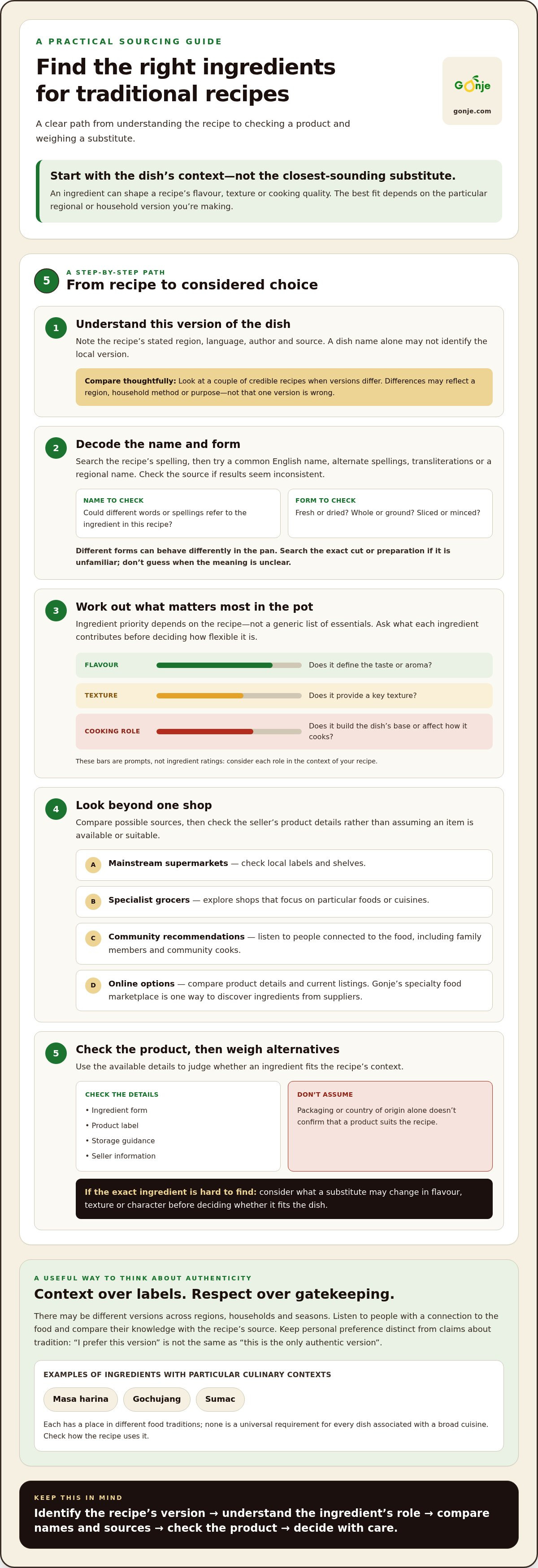
▮How to check labels, quality, and possible substitutions
A product can look familiar and still differ from what the recipe needs. Check the details before you buy. Match the ingredient name and physical form to the recipe, then read the ingredients list and any preparation notes. Look for storage instructions and use-by information, and check who is selling it. If storage or handling guidance is unclear, consult Food Standards Australia New Zealand (FSANZ) information or ask the seller.
What to check on the product listing or label
Compare the wording with the recipe. Does it call for an ingredient that's whole, ground, fresh, dried, fermented or prepared in a particular way? Check that the listed ingredients and preparation details fit. Packaging and country of origin can help describe a product, but neither alone proves it will suit a particular dish. If something important is missing, ask the seller for clarification before ordering.
These checks are a practical part of how to find authentic ingredients for traditional recipes. They help you judge whether a product fits the recipe instead of relying on a broad label or an appealing picture.
When a substitution makes sense
Consider what the ingredient does before swapping it. A close alternative may bring a different flavour, texture or colour, or behave differently during cooking. Keep defining ingredients where possible. If you need to adapt a less central element, note the change and adjust the dish with care. Treat a substitute as a practical option, not an identical or universally authentic replacement.
Use this table as a prompt for checking, not a fixed substitution guide. The right choice depends on the recipe and the product you find.
| Recipe ingredient | Possible alternative | Likely change | Check before using |
|---|---|---|---|
| Whole spice | Ground version | Different texture and intensity | Does the recipe toast, grind or simmer it whole? |
| Fresh herb | Dried version | Less fresh character and a different texture | Does the recipe rely on the herb being fresh? |
| Specified grain or flour | Another type or grind | Possible change to texture and cooking behaviour | Does the recipe name a particular grain, grind or preparation? |
When a label or listing leaves you unsure, pause rather than assume. Check the product details and ask the seller about the form, ingredients or storage information you need. To look for specialty food listings, explore Gonje's specialty-food marketplace, then confirm current listings and delivery availability before choosing.
▮A practical ingredient-finding plan for your next traditional recipe
A little checking before you shop can save guesswork later. Use this five-step plan to move from a recipe to an informed ingredient choice, whether you're visiting a grocer or checking an online listing.
A five-step checklist before you shop
- Write down the recipe version. Note the dish name, its stated region and where the recipe came from. This gives your search useful context.
- List the ingredients as written. Keep original spellings and any English names together. Mark unclear terms for checking rather than guessing.
- Prioritise what matters. Note which ingredients shape the dish's flavour, texture or cooking method. Separate these from items the recipe uses as a finishing touch.
- Compare possible sources. Check supermarkets, specialist grocers, community recommendations and online listings. If information isn't clear, ask sellers about the ingredient's form, origin details, storage and suitable uses.
- Confirm before buying. Match the product name and form to the recipe. If you're considering an alternative, note what it may change and decide whether that trade-off suits the dish.
Make the next cook easier
Keep a short note with the recipe. Record confirmed spellings, the product form that worked, useful answers from sellers and where you found reliable information. If you used a substitute, jot down how it affected the flavour or texture. Your notes can make the next search quicker without turning one cook's choice into a rule for every version of the dish.
That's the heart of how to find authentic ingredients for traditional recipes: follow the context of the recipe, check what you're buying and be clear about any adaptation. If you're still looking, explore Gonje's specialty-food marketplace as one way to discover ingredients from suppliers. Check current listings and product details, including delivery availability, before choosing an item.
▮Bring the right ingredients to your next cook
Finding the right ingredient starts with understanding the recipe in front of you. Check its regional context, identify which ingredients shape the dish, then compare names, forms and seller details before you buy. If the exact item isn't available, choose a substitute with care and consider what it may change.
That's a practical way to approach how to find authentic ingredients for traditional recipes: respect the recipe's roots, ask informed questions and keep notes for next time. Your choices don't need to be perfect. They need to be considered.
Gonje connects Australian consumers with multicultural specialty foods and regional ingredients through local suppliers, with delivery across Australia. Listings and availability can vary, so check current product details before choosing. Explore Gonje's specialty foods to discover ingredients for your next recipe.
Take the time to check, then enjoy the cooking. Each dish is another chance to learn, share and bring a little more of its story to the table.
▮Frequently Asked Questions
How can I tell whether an ingredient is authentic for a traditional recipe?
Check whether the ingredient fits the recipe's particular region, version and method. Look beyond a product's "traditional" or "authentic" wording. Compare the recipe's name for the ingredient with the product name, form and preparation details. If the recipe's source or meaning is unclear, check another credible recipe or ask someone familiar with that food tradition. Suitability depends on the dish, not a label alone.
Where can I find hard-to-find international ingredients in Australia?
Try the supermarket international aisle for familiar pantry items, then look to specialist grocers for less common regional ingredients. Community recommendations can help you find useful sellers or alternate ingredient names. Online marketplaces are another option when nearby shelves don't have what you need. Check product details and ask the seller about form, origin information and suitable uses before buying. Stock and delivery availability can vary.
Can I substitute an ingredient in a traditional recipe?
Yes, if you understand what the change may do to the dish. An alternative can affect flavour, texture, colour or cooking behaviour, so consider the ingredient's role first. Try to keep ingredients that define the recipe, and adapt less central elements with care. A substitute may be practical, but it isn't automatically equivalent or authentic for every regional version. Note what you changed and how the finished dish turned out.
How do I check whether an unfamiliar ingredient is the right type?
Match the product listing or label to the recipe's exact wording and preparation. Check whether it calls for a fresh or dried ingredient, whole or ground, or a particular cut or form. Read the ingredients list and storage details where supplied. If the name or use remains unclear, ask the seller a specific question. Don't rely on packaging or country of origin alone to decide whether it suits the dish.
Do traditional recipes always have one authentic version?
No. A dish can have different versions shaped by region, household, season and available ingredients. A family recipe and a published recipe may both reflect meaningful traditions, even if their methods differ. Compare sources to understand which version you're following, rather than treating one recipe as the only legitimate authority. It also helps to separate personal preference, such as liking extra spice, from a claim about what a tradition requires.
Can I find traditional recipe ingredients online?
Yes. Search the ingredient name alongside the dish or region, and try alternate spellings if results differ. Read the seller's description carefully, especially details about form, ingredients and storage. Gonje connects Australian consumers with multicultural specialty foods and regional ingredients through local suppliers, with delivery across Australia. Check current listings and product details, including delivery availability, before choosing. Online listings are a useful starting point, not a guarantee that a particular ingredient is available.
 Tiktok
